



Why is everyone suddenly rethinking STEM education?
If you’ve been anywhere near STEM education lately, you’ve probably noticed something feels… unsettled.
It’s not just one thing. It’s a mix of rapid AI development, shifting expectations from schools and parents, and changes happening in major programs like FLL. People aren’t just looking for “good tools” anymore — they’re questioning the whole structure of how STEM is taught.
A recent academic paper on AI and STEM education points out a key shift: learning is no longer about exposure. It’s about capability. That means students need to build real skills like problem solving, critical thinking, and creativity — not just complete tasks or follow instructions.
And that’s where the tension starts. Because a lot of existing STEM setups weren’t designed for that.
What does AI actually change about how kids should learn?
AI changes the goal.
Before, it was enough for students to learn how to code, build, or follow a process. Now, those skills alone aren’t enough. Students need to understand systems, think independently, and adapt when things don’t go as expected.
That’s a very different type of learning.
Instead of asking “Can you complete this task?”, the better question now is “Can you figure things out when there is no clear answer?” This is where a lot of traditional coding classes and robotics activities start to feel limited. They’re often built around fixed outcomes. Students follow steps, complete a challenge, and move on.
That works for engagement. But it doesn’t always build depth.
Why are robotics kits getting more attention — and more scrutiny?
Robotics kits used to be an easy win in STEM education. They were engaging, hands-on, and felt modern.
But now people are looking closer.
Parents and educators are asking whether these tools are actually helping kids develop long-term skills, or if they’re just another form of structured play. On top of that, incidents like the Sphero data breach — where information from over a million users was potentially exposed — have added a new layer of concern around privacy and security in connected learning tools.
So expectations are changing.
A robotics kit for beginners is no longer just about building something that moves. It needs to support real learning, be safe to use, and ideally grow with the student over time.
What are people looking for now, especially after the FLL changes?
There’s a quiet shift happening in the background.
For years, competitions like FLL gave schools and educators a clear structure. You had a timeline, a goal, and a sense of progression. But as things evolve, more people are realizing how dependent that model was on external systems. Now the question is different. Not “What competition should we join?” But “What learning system should we build?”
Educators are looking for something more stable — something that doesn’t disappear or change direction every season. Parents are asking what actually helps their kids develop skills, not just participate.
That’s where the gap is right now.
What does the research suggest — and where does it fall short?
The academic side is clear about direction. There’s a strong push toward integrating AI thinking early, encouraging exploration, and helping students connect ideas across subjects. That all makes sense.
But research doesn’t always translate cleanly into real-world classrooms or homes. It tells you what matters, but not always how to implement it in a way that works day-to-day, especially for younger kids or beginners.
That’s the missing piece most people are trying to figure out.
So how does WhalesBot approach this differently?
Instead of treating robotics as a one-time activity or a competition tool, WhalesBot is built more like a learning system.
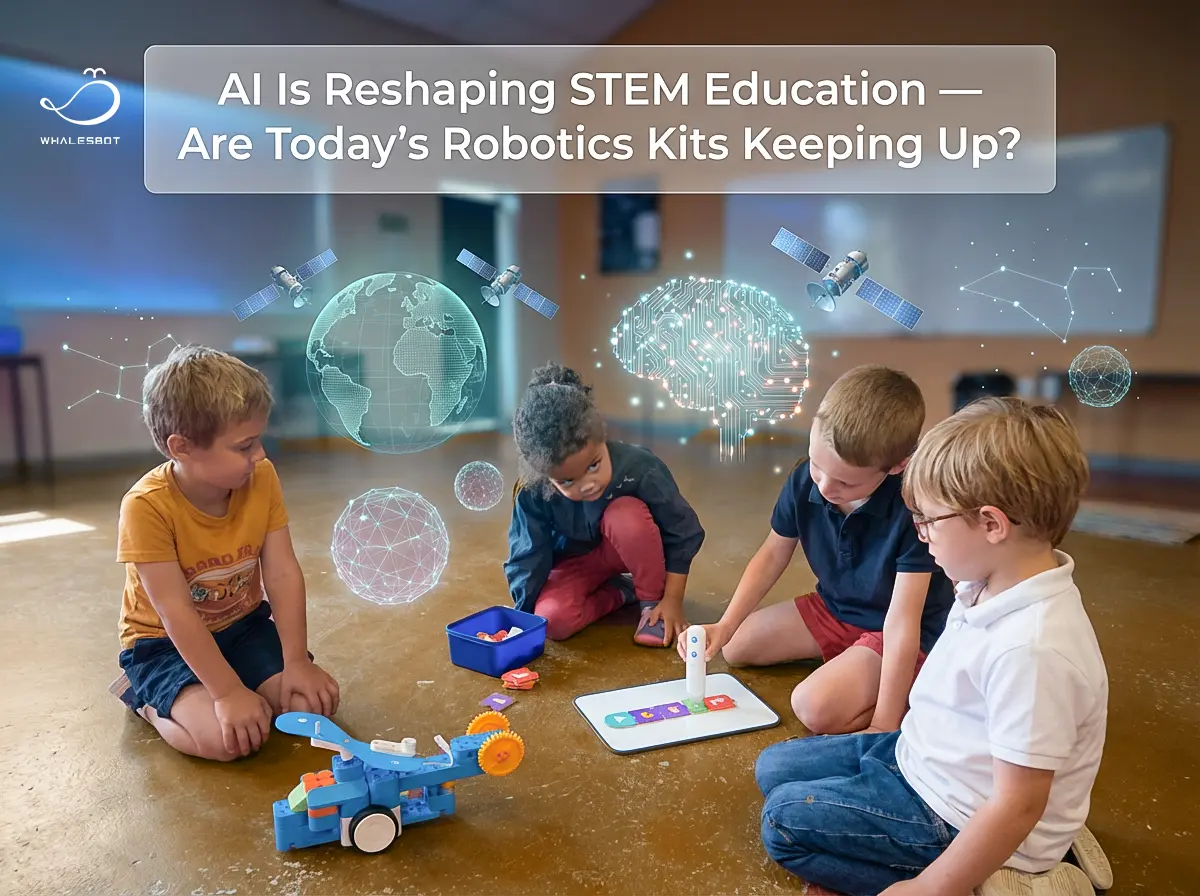
It starts earlier than most. For younger kids, jumping straight into screens and coding platforms can be overwhelming. That’s why WhalesBot leans into screen-free coding — using physical tools like coding blocks and magnetic cards to teach logic in a way that feels natural.
This approach does two things at once. It reduces screen time, which parents care about more than ever, and it makes abstract concepts like sequencing and logic easier to understand because kids can literally hold and move them.
As students grow, the system grows with them. Instead of stopping at simple builds, they move into more advanced projects, deeper coding concepts, and eventually into areas that connect with AI thinking.
That progression matters. Because real learning isn’t about a single moment of success — it’s about what happens next.
What should educators and parents actually focus on now?
There’s no perfect answer right now, but there is a clear direction. It’s less about finding the “best” robotics kit or coding tool, and more about choosing something that supports long-term development. Something that builds thinking, not just results. When you look at coding for kids or any STEM robot toys, it’s worth asking a few simple questions.
Does this help kids think, or just follow instructions?
Does it grow with them, or will they outgrow it quickly?
Is it engaging beyond the first few uses?
And importantly, is it safe — both physically and digitally?
Those questions matter more now than ever.
Final thought: this is a transition moment, not a finished answer
STEM education is in the middle of a shift. The old model — structured, competition-driven, outcome-focused — isn’t disappearing overnight. But it’s no longer enough on its own. The new model is still forming. It’s more flexible, more focused on thinking, and more connected to real-world skills. That’s uncomfortable, because it means there isn’t a clear playbook yet. But it also creates space. For new approaches. For better systems. And for tools that actually match how kids need to learn today. And if we get this part right, everything that comes after — AI, robotics, whatever’s next — becomes a lot easier to build on.

.png)
