

Artificial intelligence is no longer a distant or abstract concept. From recommendation systems to smart devices, AI increasingly shapes how we live, learn, and make decisions. Yet in many K–12 classrooms, AI education is still treated as an add-on — a short workshop, an enrichment activity, or an advanced elective offered to only a small group of students.
Recent evaluations of K–12 AI education suggest that this approach is not enough. If AI education is to be sustainable and meaningful, machine learning concepts must be embedded into existing K–12 learning pathways, rather than taught as a standalone subject disconnected from students’ everyday learning experiences.
The Limits of Isolated, Code-First AI Instruction
Many current AI education initiatives rely heavily on traditional programming-based instruction. While coding is undoubtedly valuable, introducing machine learning primarily through text-based programming languages can unintentionally raise barriers for younger learners and beginners.
Students without prior coding experience often encounter frustration or anxiety when asked to engage with abstract code before understanding what AI systems actually do. Instead of developing curiosity, some learners quickly conclude that AI is “too difficult” or “not for them.” At the same time, students with stronger technical backgrounds may progress more quickly, widening gaps within the same classroom.
Over time, these differences can affect participation, collaboration, and students’ confidence in STEM — outcomes that run counter to the inclusive goals of K–12 education.
Why Machine Learning Belongs Inside the Curriculum
A growing body of research points to a more effective approach: embedding machine learning concepts into existing subjects and learning structures. When students encounter AI ideas through familiar contexts — such as patterns in mathematics, data in science, or decision-making in real-world scenarios — they are able to engage with core concepts without first mastering complex code.
This shift moves the focus away from how to program and toward how intelligent systems work, including:
how data influences outcomes
how models make predictions
where limitations and bias can appear
how AI systems interact with the real world
By embedding machine learning into regular classroom activities, AI literacy becomes part of students’ everyday learning journey rather than a one-off experience.
How U10 Pro Supports Foundational AI Readiness
The WhalesBot MakeU U10 Pro serves as a systems-based robotics learning platform designed to cultivate these foundational competencies. Its role strengthens the structured thinking that advanced AI education requires.
Key features include:
Magnetic electronic modules that make circuit architecture visible and physically manipulable
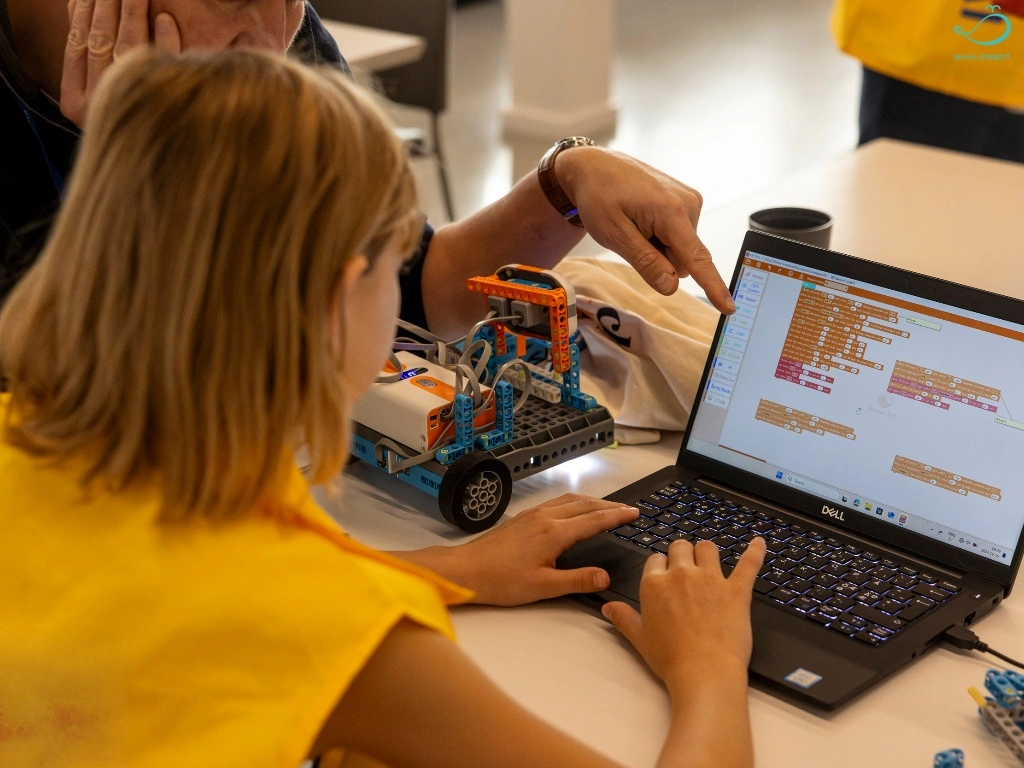
Block-based programming interfaces that reduce syntactic complexity
Integrated sensors (sound, touch, light, infrared) that demonstrate how environmental inputs influence system behavior
Progressive construction pathways that introduce increasing levels of logical coordination
Through hands-on experimentation, students observe how adjustments in input produce predictable variations in output. They engage in iterative design, test structured logic, and coordinate multiple components within a system.
This experiential process mirrors the conceptual logic underlying machine learning: systems interpret input according to defined structures and generate corresponding outcomes. By internalizing these relationships through tangible interaction, learners develop the cognitive scaffolding necessary for later AI study.
Lower Barriers, Broader Participation
Embedding machine learning into K–12 education is not only about content — it is about access. When AI concepts are introduced through hands-on exploration rather than abstract code, more students are able to participate meaningfully, regardless of prior experience.
This approach also supports teachers. By aligning AI learning with existing curriculum goals and classroom structures, educators can integrate AI concepts more naturally into their teaching, rather than treating them as separate or optional topics.
Rethinking the Goal of K–12 AI Education
The goal of AI education should not be to turn every student into a programmer. Instead, it should help learners understand how intelligent systems work, how they affect society, and how humans can interact with them thoughtfully and responsibly.
Rather than teaching AI concepts directly, WhalesBot MakeU U10 Pro focuses on building the underlying thinking skills that future AI learning requires — helping students become comfortable with systems, logic, and cause-and-effect through hands-on exploration, which is neccessary for kids.
What Does It Really Mean to Prepare Students for an AI-Driven World?
Preparing students for an AI-driven world is not about adding more advanced technology courses or pushing coding earlier and earlier. It is about helping learners develop a foundational understanding of how intelligent systems work as part of their everyday learning. When machine learning is embedded into the K–12 curriculum through hands-on, tangible experiences, students can explore ideas like data, decision-making, and cause-and-effect in ways that feel natural and accessible. Rather than positioning AI as something distant or intimidating, this approach makes it a normal part of how students learn to think—building confidence, curiosity, and understanding that will support future learning long after specific tools or technologies change.