

The Missing Dimension in STEM Learning
Walk into a lively STEM classroom, and you may see a familiar kind of energy. In one corner, students are snapping pieces together to build a robotic arm. In another, a small robot follows a line across the floor. On a nearby screen, colorful coding blocks click into place.
These are valuable moments of learning. Students are building, testing, adjusting, and seeing their ideas take shape.
But step back for a moment, and another question appears: how much of this learning helps students understand technology in open, three-dimensional space?
Many STEM activities begin on screens, tables, or flat surfaces. That is often the right place to start. It makes learning accessible, structured, and easier to control. But the real world is not always flat or predictable. Technology moves through space, responds to timing and direction, and behaves differently when height, distance, speed, and balance come into play.
This is where educational drones can add a different layer to STEM learning. They do not replace other tools in the classroom. They bring in something many classroom tools cannot fully show: how technology behaves when it moves through real space.
Before Coding, Students Learn Through Control
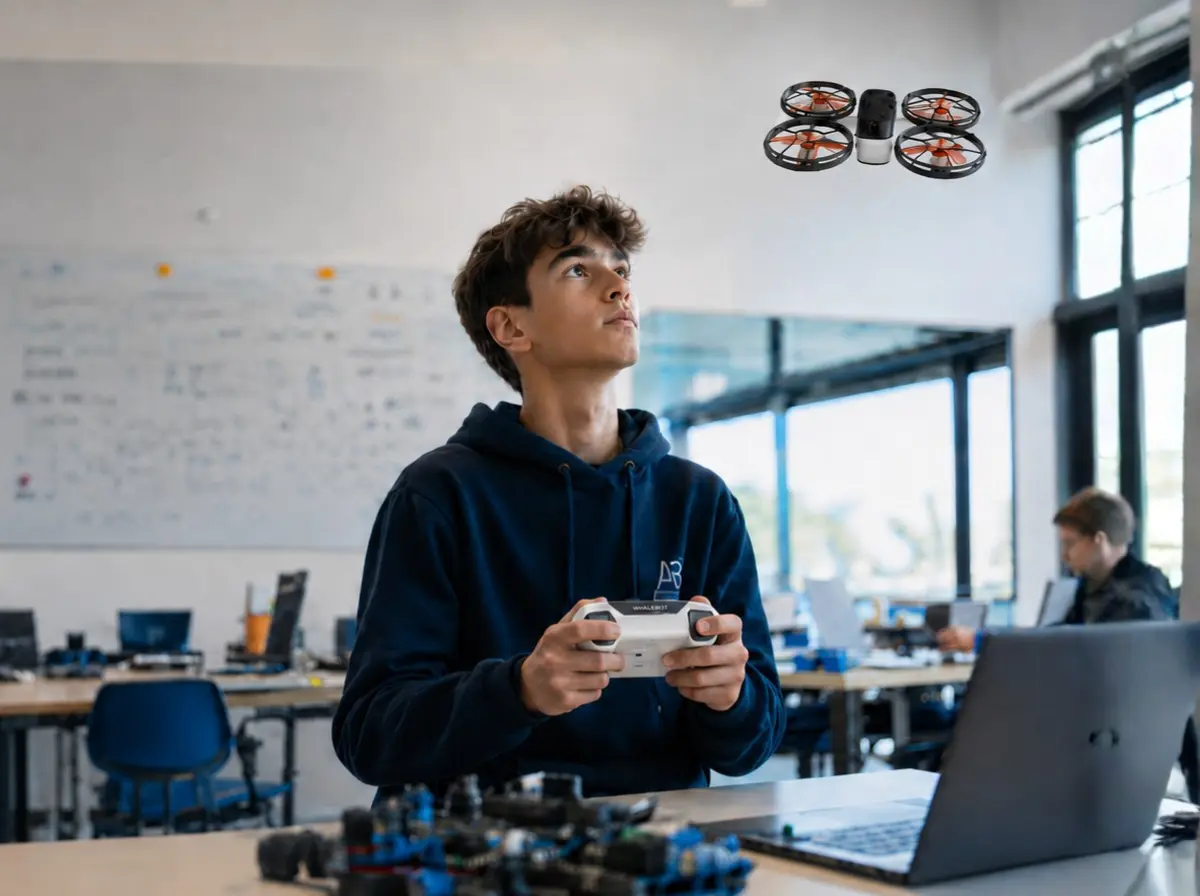
One of the first things educators often notice in a drone activity is how quickly students become focused. When a drone lifts off, students do not just watch a device move. They follow it with their eyes, adjust their hands, judge distance, and react to what happens in the air.
For younger learners, this is already a meaningful STEM experience. Drone learning does not have to begin with programming. It can begin with simple flight practice, observation, and control. Guiding a drone through space helps children build hand-eye coordination, spatial awareness, direction judgment, timing, and focus.
A simple classroom challenge can make this even clearer. Students may be asked to guide a drone through a route, stop near a target, avoid an obstacle, or complete a small team task. At this stage, they are not only “playing with a drone.” They are learning how movement changes with control, how small decisions affect outcomes, and how to adjust when reality does not match their plan.
This is an important starting point. Before students write code, they first learn to observe motion, understand space, and develop a sense of cause and effect in the physical world.
When Programming Becomes Visible
As learners grow more confident, the same drone experience can gradually move from flight control to programmed flight.
For older students, drones create a natural bridge between physical movement and programming logic. When students program a drone, code no longer stays as abstract instructions on a screen. It becomes takeoff, direction, distance, turning, hovering, and landing in real space.
This makes programming logic easier to understand because students can see what their instructions actually do. A command like “move forward” is no longer just a block or a line of text. It becomes distance and motion. A turn changes the flight path. A pause affects timing and control. A small change in sequence, speed, or direction can immediately change what happens next.
When the drone does not move as expected, the result also becomes visible feedback. Students can ask better questions: Was the order wrong? Was the distance too long? Did the drone respond to the right input?
In this way, coding becomes less about finding the “right answer” and more about understanding the relationship between intention, instruction, action, and outcome.
The STEM Behind Every Flight Path
Once students move from basic control to programmed missions, they begin to see something even bigger: drone learning brings multiple STEM concepts into one connected experience.
To complete a flight task, students often need to think beyond the code itself. They may need to estimate distance, adjust speed, plan direction, consider timing, or understand how a change in angle affects the flight path. What looks like a simple route can quickly become a lesson in spatial thinking, measurement, physics, and cause and effect.
As tasks become more advanced, students can also explore how sensors help a drone respond to its surroundings. Instead of only telling the drone what to do, they start thinking about how a system receives information, makes a response, and changes its behavior based on real-world input.
This is what makes drone learning valuable for STEM education. It does not separate flight, programming, math, physics, engineering, and sensor logic into different boxes. It brings them together through one visible challenge, helping students understand how different ideas work together to solve a real problem.
Why Process Still Matters in the AI Era
In the AI era, students can produce outcomes faster than ever. A prompt can generate an answer. A tool can complete a task. But when technology becomes too seamless, students may start to focus only on the result, without understanding the process behind it.
That is a real challenge for STEM education.
The future will not only need students who can use intelligent tools. It will need students who can question how those tools work, test their limits, and understand why a system produces one result instead of another.
This is why hands-on STEM learning still matters. It slows the process down and makes it visible again. With drone-based learning, students do not only see an output. They see the path from intention to action, from action to feedback, and from feedback to improvement.
In a world where more technology feels automatic, this kind of learning helps students build a more active relationship with technology. They are not just asking, “What can this tool do?” They are learning to ask, “How does this system work, and how can I make it better?”
Putting Drone-Based STEM Learning into Practice
At WhalesBot, we see educational drones as flexible learning tools that can support different stages of STEM exploration, from basic flight control to programming, building, sensor exploration, and system-level thinking.
This idea runs through the WhalesBot Eagle series. Each model offers a different entry point into drone-based STEM learning.
Eagle 1003 focuses on real-world programmable learning, helping students connect flight control with coding practice through hands-on tasks. With Eagle 125F, game-based drone activities can become part of active classroom learning. Eagle 2001 gives students more room to build, transform, and fly, supporting exploration around structure, movement, and design. Eagle 3002 adds FPV, programmable flight, sensors, and expandable functions for learners who are ready to explore drone systems in greater depth.
Together, the Eagle series supports a progressive learning path where students can begin with flight practice, move into structured challenges, explore programming, and gradually understand how different parts of a system work together.
Want to explore more educational drone solutions for STEM classrooms? Visit our Eagle series overview, and stay tuned for our next blog, where we will introduce the full WhalesBot drone product lineup.
Learn more about the Eagle series:
https://www.whalesbot.ai/products/drone