

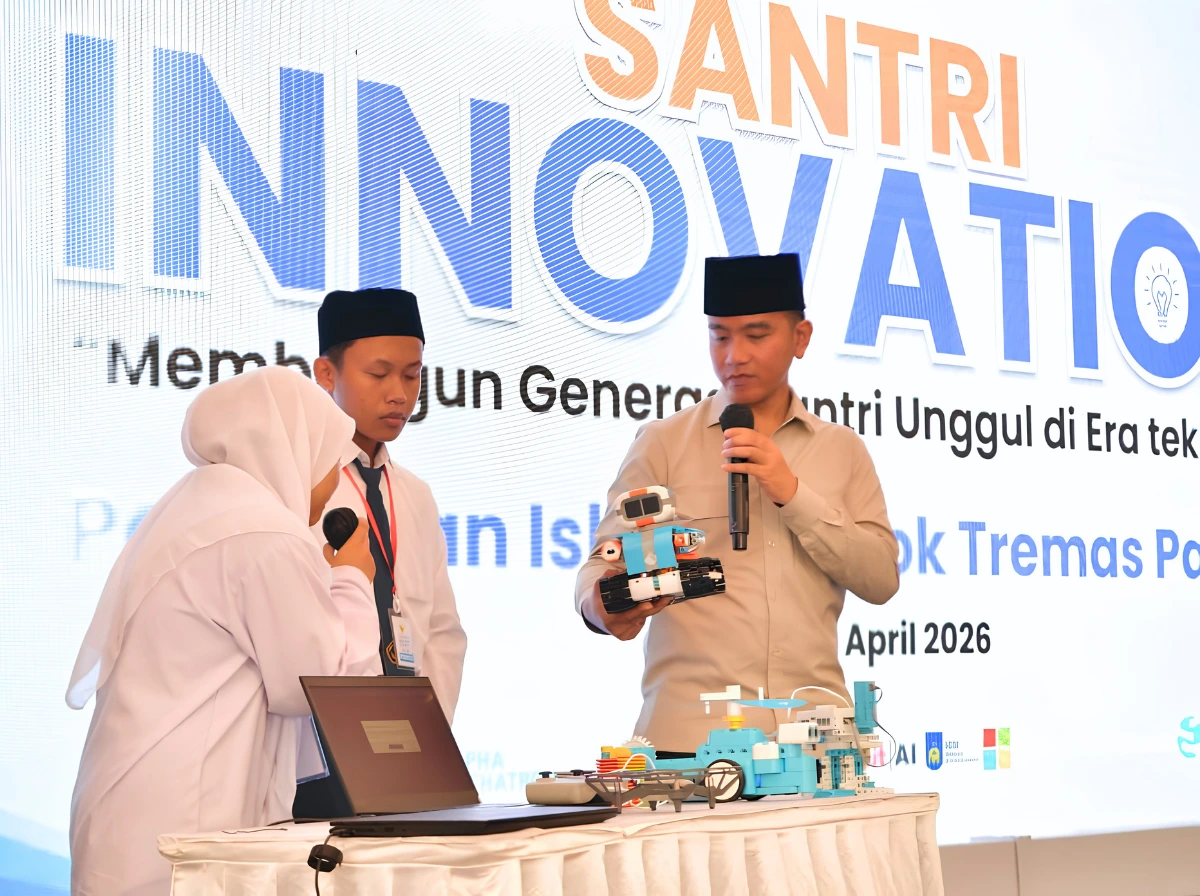


A Hands-on Robotics Moment at Pondok Pesantren Tremas
There is a special moment in hands-on learning when technology stops feeling distant.
It happens when a student connects a part, runs a program, and watches a robot respond to an idea they created. In that moment, technology is no longer something students only read about or observe from a distance. It becomes something they can touch, test, question, and improve through their own actions.
That moment became part of a two-day robotics and AI education program at Pondok Pesantren Tremas in Pacitan, East Java, Indonesia. On April 30, Indonesian Vice President Gibran Rakabuming visited the school to observe students as they showcased the results of their training using WhalesBot robots.
The program brought together 30 senior high school students from the Islamic boarding school for hands-on robotics education and AI learning. The robotics training was organized by ARKAI and Koding Next, while the AI training was supported by Microsoft Indonesia and NU Care Global. Together, the program gave students a chance to move from observing technology to actively building, programming, and exploring it.
Using WhalesBot AI module series, students explored how ideas could become real actions. They assembled robotic structures, practiced coding, tested different commands, and observed how each decision could lead to movement, response, or the need for adjustment. Instead of simply learning what robotics is, they experienced how robotics works through trial, feedback, and hands-on problem-solving.
This is where educational robotics becomes meaningful. A line of code becomes movement. A mistake becomes a chance to debug. A challenge becomes a way to develop computational thinking, critical thinking, and problem-solving skills.
For students in the digital era, this kind of learning matters because AI and robotics education are not only about bringing new technologies into the classroom. They are about helping young learners build the confidence to understand technology, work with it, and begin creating with it.
Not Just Users of Technology, but Creators
During the visit, Vice President Gibran Rakabuming reminded students that learning robotics, artificial intelligence, and coding is essential for building critical thinking and computational thinking. In a fast-changing digital era, these skills help students do more than keep up with technology. They help students understand it, question it, and create with it.
“Facing the challenges of the future digital era is very important. Everyone must learn this, and students must not be left behind,” the Vice President said.
One student raised a concern many young people may quietly share: if robots and AI continue to advance, will human jobs be replaced?
The Vice President’s answer was clear. Technology may change the future of work, but it is still shaped, guided, and created by people.
“Who makes robots? Humans, right? AI generates prompts, but in the end, humans are still the ones who input them, right? In fact, this will create many new jobs. So, do not be afraid. Humans will not be replaced,” he explained.
This exchange captured why STEM education matter. The point is not to make students fear the future, nor is it simply to teach them how to operate new tools. The point is to help them build the confidence and thinking skills to keep learning as technology changes.
When students build, code, test, and improve a robot, they practice more than technical skills. They learn how to think through uncertainty, solve problems, and turn ideas into working solutions.
KH Luqman Harist Dhimyathi, leader of Pondok Pesantren Tremas, also expressed hope that the training would continue beyond the two-day program, noting that students were excited by the experience and felt they had gained valuable knowledge through technology, IT, AI, and related learning.
Together, these moments point to a simple but important shift: students in the digital era should not only watch technology change the world. They should be prepared to take part in shaping it.
From STEM Awareness to STEM Practice
The story at Pondok Pesantren Tremas is not an isolated one. It reflects a broader question now facing many education systems in Indonesia and beyond: how can digital skills move from policy discussions into real learning experiences for students?
In Indonesia, AI education, STEM learning, and digital talent development are becoming increasingly important parts of the national education conversation. In 2025, Indonesia launched STEM Indonesia Cerdas, a national initiative designed to strengthen STEM and AI learning for a broader generation of students. What makes this especially relevant is its focus on diverse learning environments, including public schools, private schools, madrasah, and pesantren. Future-ready learning is not being treated as something reserved only for technology hubs or elite institutions. It is being brought closer to the students and communities who will experience digital transformation directly.
At the same time, Indonesia is also working to build a stronger AI talent pipeline. The country’s AI Talent Factory program emphasizes collaboration between government, academia, and industry, with a focus on real-life case studies and AI-based solutions. Reuters has also reported that Indonesia is moving forward with a national AI roadmap, while still facing challenges such as talent shortages and uneven digital infrastructure. Together, these efforts show that AI and STEM education are becoming part of a larger national conversation about future skills, inclusion, and digital readiness.
This is why hands-on STEM learning matters. National strategies and digital roadmaps can set the direction, but students need real learning experiences that help them connect technology with action. They need to build, test, fail, adjust, and try again. Through educational robotics, AI and coding education can become more than concepts. They become a way for students to practice computational thinking, critical thinking, and problem-solving in a visible and tangible way.
This shift is not only happening in Indonesia. Around the world, education systems are asking a similar question: how can students prepare for a future shaped by AI, robotics, and rapid technological change?
The answer cannot be only more devices, more apps, or more information. Students in the digital era need to become more than technology consumers. They need the confidence and ability to understand how technology works, judge its impact, and create with it.
That is the deeper value of robotics education. It gives students a place to start. A robot becomes more than a machine in the classroom. It becomes a bridge between knowledge and action, curiosity and creation, and learning about the future and taking part in shaping it.
Supporting the Next Generation of Technology Creators
For WhalesBot, this is exactly the kind of learning experience educational robotics should support.
A robot in the classroom is not valuable only because it moves, responds, or completes a task. Its deeper value lies in what happens around it: students asking questions, testing ideas, making mistakes, trying again, and beginning to see technology as something they can understand, shape, and create with.
That is why WhalesBot continues to focus on hands-on STEM learning. Through robotics education, students can move step by step from basic exploration to more advanced creation. They can experience coding education not as a separate subject, but as a way to connect logic, creativity, and real-world problem-solving.
The program at Pondok Pesantren Tremas showed what this can look like in practice. With the right tools, guidance, and learning environment, students can begin to see themselves not only as users of technology, but as future creators with the confidence to build, question, and innovate.
As AI and robotics continue to reshape education, WhalesBot will keep working with partners around the world to bring hands-on learning experiences to more schools, communities, and young learners.
The future of STEM education is not only about helping students keep up with technology. It is about helping them take part in creating what comes next.


