

For many schools, the question is no longer whether students should learn about AI. The harder question is how to make AI learning practical, structured, and possible to deliver in real classrooms.
To make AI education meaningful, schools need a learning pathway that helps students understand AI, build with intelligent systems, apply ideas through projects, and show what they have learned through visible outcomes.
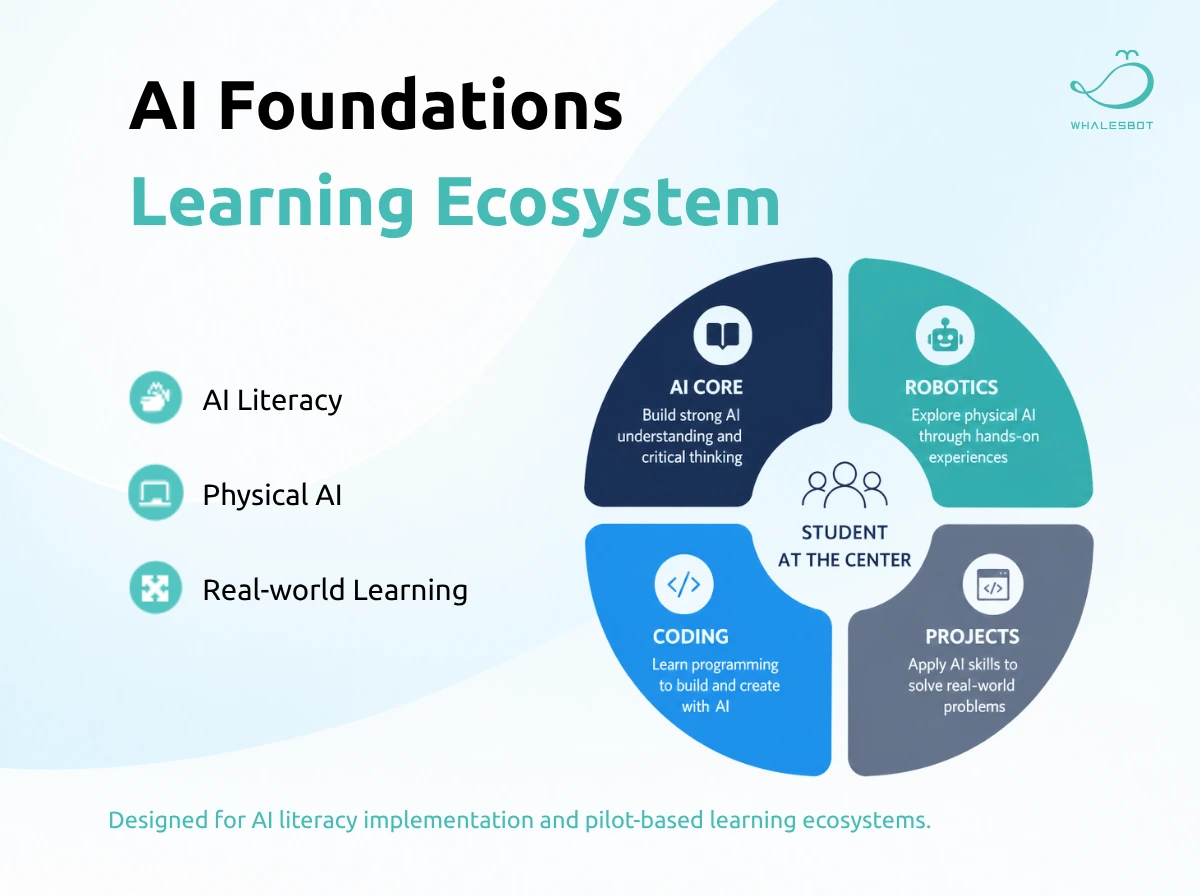
At WhalesBot, we approach this through AI Foundations Learning, a practical framework that connects learning progression with the classroom support schools need for implementation. It brings together AI literacy, physical AI, teacher support, project learning, assessment, and competition-based practice into one connected ecosystem.
In this article, we look at why schools need a practical AI Education Framework, what this pathway can include, and how WhalesBot’s AI Foundations Ecosystem supports hands-on AI learning in real classrooms.
Why do schools need a AI Education Framework?
Schools need a practical AI Education Framework because AI education can easily become fragmented. In many classrooms, students may try an AI tool, complete a short activity, or learn basic concepts, but these experiences do not always connect into a deeper understanding of how AI works or how it can be applied.
For schools, the challenge is not only introducing AI, but organizing it in a way that teachers can deliver and students can continue to build on. A structured pathway helps move AI learning from scattered exposure to continuous AI literacy development. It connects what students learn, what they build, and how they apply their thinking in real-world contexts.
This also reflects a broader shift in education. The World Economic Forum describes AI literacy as a core competency, while UNESCO emphasizes that students should be prepared as responsible users and co-creators of AI.
AI education needs this shift in three important ways:
· From concepts learned to application practiced
Students may understand AI-related terms, but still struggle to use them in meaningful tasks. Hands-on projects, coding tasks, robotics activities, and problem-solving challenges help turn theoretical understanding into practical experience.
· From isolated AI lessons to real-world context
AI should not feel like a separate topic that appears only in one lesson or one tool activity. A practical pathway connects AI learning with real-world scenarios, where students can see how data, sensors, code, and intelligent systems work together.
· From disconnected activities to a structured AI literacy framework
Without a clear progression, AI learning can become a set of separate experiences with no long-term direction. A practical pathway gives schools an implementation framework that connects understanding, building, application, and measurable outcomes.
A Four-Stage AI Learning Progression
A practical AI Education Framework should give schools a clear structure for moving AI education from awareness to classroom practice. Instead of treating AI as a single lesson or tool activity, schools can organize learning around four connected stages: understand, build, apply, and measure.
Each stage plays a different role in helping students develop AI literacy:
· Understand AI Concepts: Students build awareness of AI concepts, including data, logic, sensing, automation, decision-making, and responsible use.
· Build with Physical AI: Students use coding, robotics, and physical AI activities to turn abstract ideas into visible actions.
· Apply Learning Through Projects: Students connect AI learning with projects, challenges, and innovation tasks that reflect real-world problem solving.
· Measure Progress Through Outcomes: Schools assess not only final results, but also how students think, build, test, explain, and improve.
Together, these stages help AI education move beyond tool exposure. Students do not only learn what AI is; they experience how ideas, code, data, and robotics systems work together in real learning contexts.
What Infrastructure Supports AI Foundations Learning?
A four-stage learning progression shows how AI learning can develop over time. But for schools, the next step is implementation: what needs to be in place for this pathway to work in real classrooms?
This is where the AI Foundations Ecosystem becomes important. It is a classroom-ready support system that connects AI literacy, physical AI, teacher support, project learning, assessment, and community and competition practice to help schools implement hands-on AI education.
This ecosystem includes six connected elements:
· AI Literacy
Helps students build foundational understanding of AI concepts, responsible use, and how intelligent systems work.
· Physical AI
Brings AI learning into hands-on robotics and intelligent systems, so students can see, test, and control real-world responses.
· Teacher Support
Provides resources and training that help teachers guide AI learning in classroom settings.
· Project Learning
Connects theory with real-world scenarios, giving students opportunities to apply what they learn.
· Assessment
Makes learning visible through outcomes, project portfolios, and continuous feedback.
· Community & Competition
Extends learning through events, collaboration, and competition-based practice.
Bringing the Framework Into One Classroom Experience
An ecosystem only becomes useful when it can be delivered in the classroom. For schools, this means the key parts of AI Foundations Learning should not remain as separate resources, but work together as one connected learning experience.
WhalesBot supports this classroom implementation through a comprehensive system where hardware, software, curriculum, and projects are designed to work together. This helps schools bring the AI Foundations Ecosystem into real teaching scenarios, making AI learning easier to organize, easier to deliver, and easier for students to experience through hands-on practice.
Hardware: Making AI Learning Physical
· Modular robotics systems
Standardized interfaces and modular components lower the barrier to building, upgrading, and project practice.
· AI-ready hardware modules
Controllers, sensors, actuators, and AI vision modules support data collection, image understanding, and environmental response.
· Scenario-based practice
Supports smart campus, smart factory, smart logistics, and competition practice scenarios.
Software: Supporting AI Practice and Coding Progression
· Core AI workflow
From data collection and annotation to model training, verification, and application.
· Creative AI expression
AI dialogue, image generation, speech synthesis, AI video generation, and model creation.
· Progressive coding journey
Graphical programming, AI-assisted programming, and Python support for step-by-step coding development.
· Software-hardware integration
AI-generated content and models can interact with hardware, making creative AI visible and tangible.
Curriculum: Supporting Pilot-Ready Implementation
· Structured course system
Covers AI literacy courses, practical operation courses, and integrated project courses.
· Rich teaching resources
Includes 192 lessons, 300+ knowledge points, 128 teaching cases, and 18 application projects.
· From concepts to projects
Connects AI cognition, multimodal models, sensors, datasets, graphical programming, and project practice.
Projects and Competitions: Making Learning Visible
· Practice-based learning evidence
Shows student progress through project outcomes, portfolios, feedback, and task performance.
· ENJOY AI global events
Provide opportunities for collaboration, challenge-based practice, and international exchange.
Together, these four implementation parts help turn AI Foundations Learning into a classroom-ready experience. Students can understand AI concepts, build with tools, apply learning through projects, and show progress through visible outcomes.
Want to explore how AI Foundations Learning can support practical, hands-on AI education in real classrooms?
Learn more about WhalesBot’s AI education approach:
https://www.whalesbot.ai/resources/ai-education