

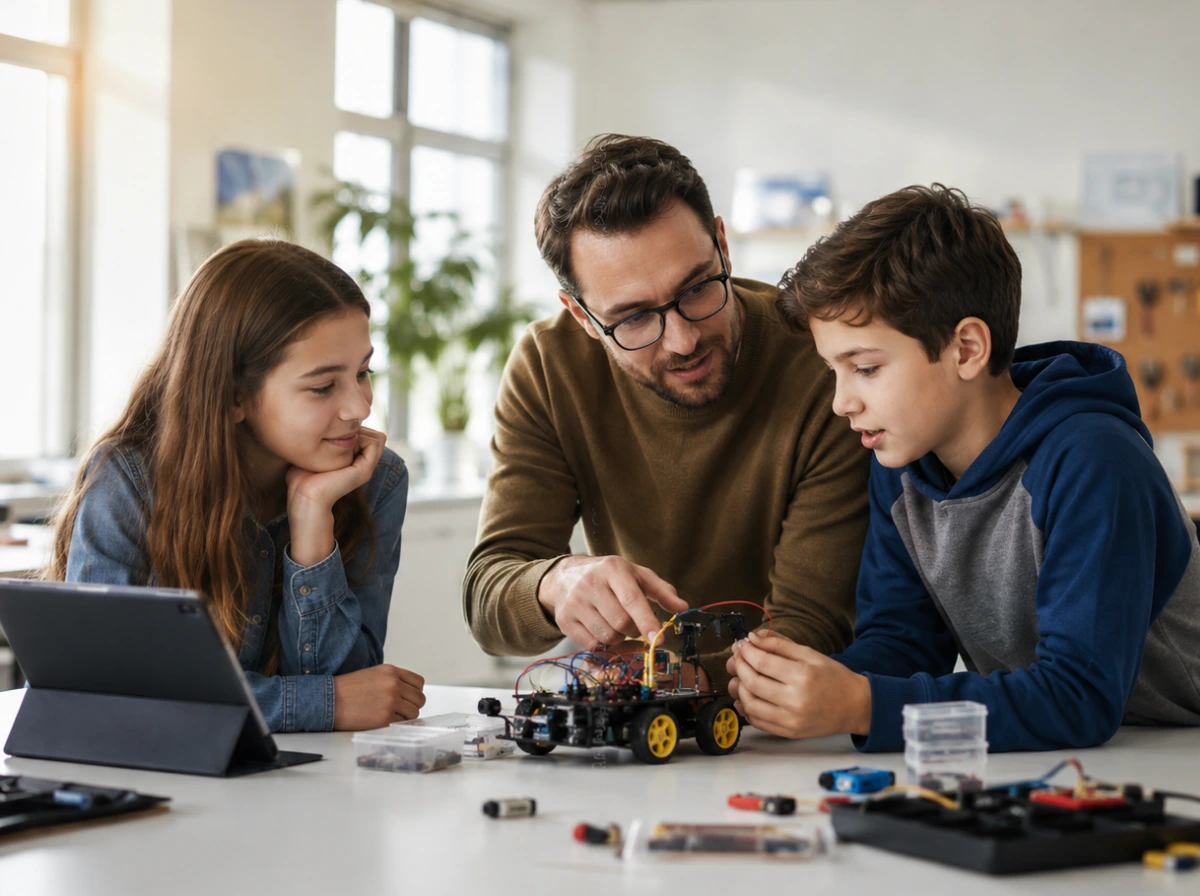


In many classrooms, STEM learning is still judged by what students build: a robot that moves, a program that runs, a drone that flies, or an AI project that produces an answer.
But the real value of STEM learning is not only found in the final output. It is found in what students practice while getting there.
Behind every working robot or successful line of code, students are doing far more than completing a technical task. They are observing, questioning, testing, adjusting, communicating and trying again. These are not side benefits of STEM learning. They are the very skills that are becoming more important as artificial intelligence reshapes how people work, learn and solve problems.
Human-centric skills are becoming future skills
As AI continues to reshape how people work and learn, technical skills are becoming essential. AI literacy, data skills and digital fluency are increasingly part of the basic skill set students will need for the future.
But technical ability alone is not enough.
The more powerful technology becomes, the more valuable human judgment, creativity, adaptability and collaboration become. AI can support writing, coding, research, calculation and content generation. What it cannot easily replace are the deeply human abilities that depend on context, empathy, original thinking and real-world decision-making.
This shift is already visible in employer demand. According to the World Economic Forum’s 2025 research on new economy skills, analytical thinking, creative thinking, resilience, flexibility, agility, motivation, self-awareness, curiosity and lifelong learning are all considered important core skills for the future workforce. Many of these skills are also expected to increase in importance by 2030.
At the same time, education systems are still struggling to develop these abilities at scale. Globally, only about 44% of executives believe public education systems are effectively developing creativity and problem-solving skills. Around 40% say the same for curiosity and lifelong learning, while only about 37% believe education systems are effectively developing resilience, flexibility and agility.
This gap matters. It suggests that some of the skills most needed for the future are also among the hardest to teach, measure and develop consistently. That is exactly why education needs to move beyond simply naming these skills in curriculum goals. Students need learning environments where these abilities are practiced again and again.
Human-centric skills cover several connected areas: creativity and problem-solving, emotional intelligence and self-management, collaboration and communication, and learning and growth. In practice, they include the ability to analyze complex problems, imagine new possibilities, listen actively, explain ideas clearly, work with others, stay resilient after failure and keep learning as the world changes.
These skills are often described as “soft skills”, but that label can be misleading. They are not soft in value, and they are not easy to build. They require time, feedback, repeated practice and real situations where students need to think, communicate and adapt.
In the age of AI, human-centric skills are not optional extras. They are becoming the foundation that allows students to use technology meaningfully, responsibly and creatively.
These skills do not grow in isolation
Human-centric skills are often discussed as if they exist separately from technical learning. In reality, they rarely develop in isolation.
A student does not become more analytical simply by hearing about analytical thinking. They do not become more collaborative by being told that teamwork matters. They do not become more creative only because creativity is written into a curriculum goal. These abilities grow when students are placed in learning situations that require them to think, interact, test ideas and make decisions.
This is where STEM learning has a unique role to play.
When designed as a continuous and structured learning journey, STEM education can connect technical knowledge with human development. It gives students repeated opportunities to move between ideas and action: understanding a concept, applying it to a task, seeing what happens, discussing the result and improving the next attempt.
That process matters because human-centric skills are deeply connected with other forms of learning. Analytical thinking, for example, supports AI learning, data interpretation, design thinking, business problem-solving, media understanding and many other fields. In this sense, human-centric skills are not the opposite of technical skills. They are the foundation that helps technical knowledge become usable, transferable and meaningful.
A student may learn how to code, but analytical thinking helps them understand why the code works. They may learn how to build a robot, but creativity helps them imagine what the robot could do. They may learn how to use an AI tool, but judgment helps them question whether the output makes sense. They may complete a project, but communication helps them explain the process and learn from feedback.
This is why effective STEM learning should not be reduced to tool training. If a lesson only teaches students how to follow instructions, the learning stops at execution. But if the lesson asks students to explore a problem, make choices, test solutions, collaborate with others and reflect on the outcome, technical learning becomes a pathway for broader skill development.
The real question is not whether students should learn technology or human skills. The real question is how learning experiences can help both grow together.
Why hands-on STEM learning matters
Hands-on STEM learning is powerful because it creates the kind of environment where multiple skills can grow at the same time.
Robotics, coding, drones and AI projects are not single-skill activities. They ask students to move through a full learning cycle: understand a problem, form an idea, choose a method, build or program something, test the result and improve it based on observation. At every step, technical skills and human-centric skills are working together.
When students build a robot, they are not only learning about structure, sensors or movement. They are learning how to break a complex task into smaller parts. When a program does not run as expected, they need to read the result, identify the problem and decide what to change. When a drone does not respond in the way they planned, they need to connect physical movement with control logic and environmental feedback.
These moments are where deeper learning begins.
A mistake in a STEM project is not simply a wrong answer. It is information. It tells students what needs to be tested again, what assumption may have been incorrect and what part of the system needs to be adjusted. This turns failure into a learning process rather than an endpoint.
That process builds resilience in a practical way. Students do not learn persistence by being told to “keep trying”. They learn it when they have a reason to keep trying. A robot that almost works, a line of code that is close but not complete, or a design that needs one more adjustment can all create that reason.
The same is true for collaboration and communication. In a well-designed STEM activity, students rarely work as isolated individuals. They explain ideas, divide tasks, listen to different approaches, negotiate decisions and present results. They learn that a good solution often depends not only on one person’s knowledge, but on how the team thinks together.
Good STEM learning does not train one ability at a time. It creates a setting where technical ability, cognitive skills and human-centric skills can grow together. Students are not only learning how to build, code or operate a tool. They are learning how to analyze, create, collaborate, express, fail, reflect and improve.
This also explains why these skills need continuous practice. Human-centric skills are not mastered once and kept forever. If students lack regular opportunities for collaboration, feedback, expression, exploration and real interaction, these abilities can weaken over time. They need to be used, challenged and strengthened through repeated experience.
A single project can spark interest. But a continuous STEM learning journey can build habits of thinking, communicating and problem-solving that stay with students long after the project ends.
Technology should create more room for thinking
As AI becomes more capable, the role of educational technology should not be to make learning effortless. It should be to make meaningful learning more possible.
Technology can provide tools, feedback and interactive environments. It can help students see how code becomes movement, how sensors respond to the world and how ideas can be tested through real action. But it should not replace the student’s own judgment, curiosity, communication or reflection.
A strong STEM learning tool should invite students to think more, not less. It should create moments where learners ask why something happened, what could be changed and how a better solution might be built. It should make abstract concepts visible, but still leave room for students to explore, make choices and learn from the results.
This is especially important in AI education. Students should not only learn how to use AI tools. They also need to learn how to question outputs, evaluate information, understand context and make responsible decisions. These are human skills, and they become more important when technology becomes more powerful.
At WhalesBot, we see robotics, coding, drones and AI not simply as tools for teaching technology, but as structured learning environments where students can build confidence, curiosity, collaboration and problem-solving skills through hands-on exploration.
In the end, the real outcome of STEM learning is not only the robot that moves, the code that runs, or the drone that flies. It is the learner who becomes more curious, more resilient, more collaborative and more capable of shaping technology with purpose.
.png)

