

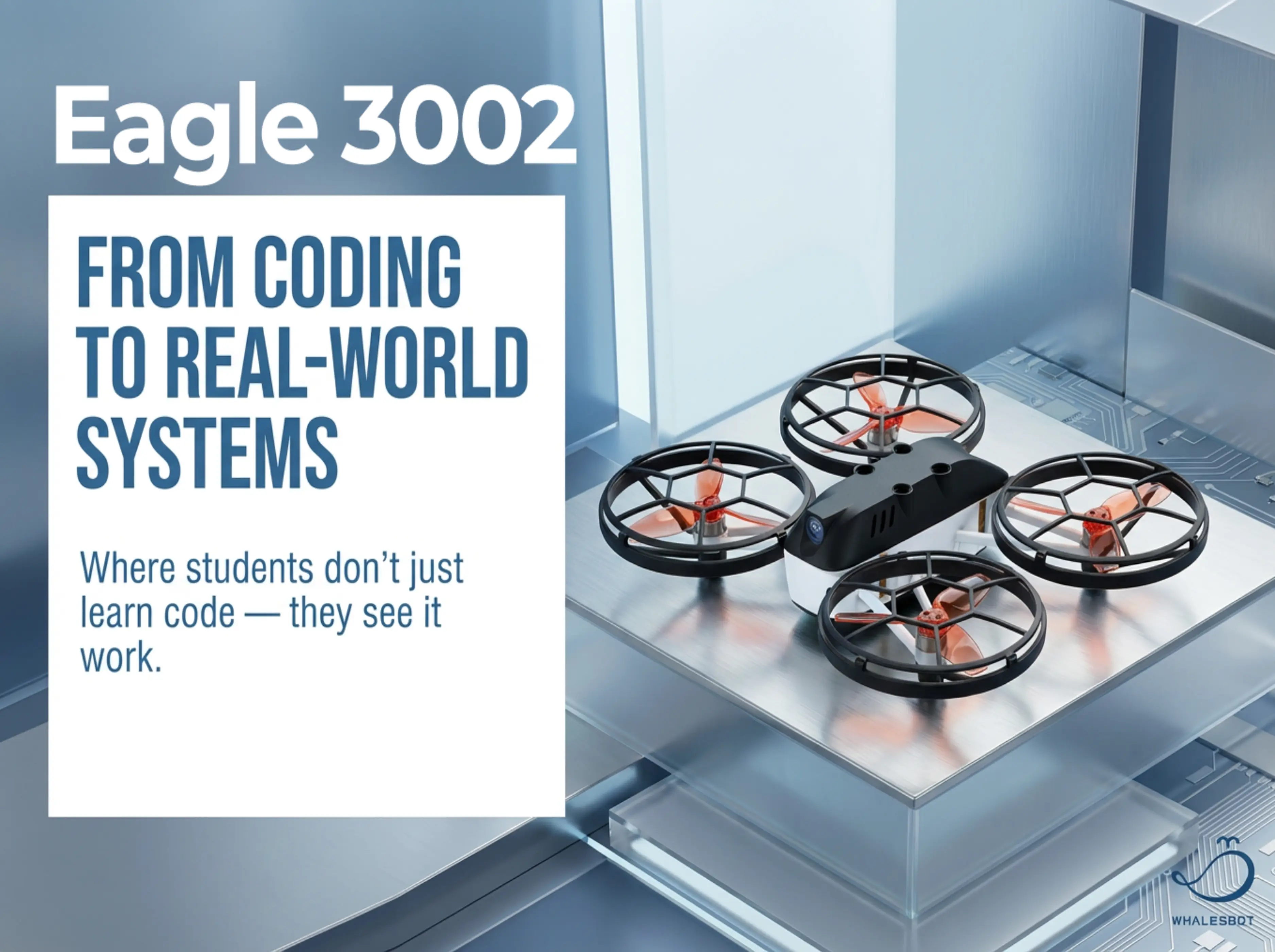


As STEM education continues to evolve, one challenge keeps coming up: how to help students move beyond writing code and actually see how it works in the real world.
One effective way to bridge that gap is through drone-based learning, where code is no longer confined to a screen, but directly translated into physical movement, real-time feedback, and spatial interaction.
Over the past year, we have seen our drones being used in classrooms by educators and partners, delivering strong results in hands-on learning and student engagement. At the same time, we also received valuable feedback. While the experience was effective, some educators pointed out that without a real-time FPV view, something was missing.
That insight stayed with us.
This year, we set out to build on that insight.
And that’s where Eagle 3002 comes in. A new educational drone designed to bring together flight, control, and programming in one hands-on experience.
But flying is only the beginning.
With Eagle 3002, learners can explore how flight works and how it can be shaped through interaction and creation. By combining real-time visual feedback with responsive control and programmable capabilities, it creates a more intuitive and engaging approach to STEM education.
What Makes Eagle 3002 Different
Building on feedback from real classroom use, Eagle 3002 introduces a set of upgrades that make flight more visible, programmable, and responsive:
· Real-time FPV view: Instead of guessing what’s happening, learners can experience flight from the drone’s perspective, creating a direct and immediate link between input and movement.
· Programmable flight: Flight becomes something learners can design, test, and refine, turning abstract code into visible, repeatable behavior.
· Multi-sensor system: By sensing and responding to its environment, the drone introduces a more dynamic layer of interaction, where actions lead to continuous feedback and adjustment.
· Expandable ports: With the ability to integrate additional sensors and modules, learners can extend functionality and explore beyond predefined scenarios.
· Brushless motor system: A more stable and responsive flight experience makes experimentation smoother, allowing learners to focus on exploration rather than control limitations.
Designed for How People Actually Learn
Eagle 3002 is designed to spark curiosity, encourage experimentation, and help learners discover how technology works by creating with it. Through building, coding, and flying, it opens up new ways to engage with the world and turn ideas into something real.
It supports a wide range of learning contexts, from first-time exploration to more structured teaching scenarios, without forcing learners into a fixed path.
But more importantly, it changes how learning feels.
Imagine a classroom where students don’t just learn code, but see it come to life. As they move from passive observation to active experimentation, abstract concepts begin to take shape. Learners can see how their code influences real-world behavior, turning ideas into tangible results.
Looking Ahead
Eagle 3002 is just one step in how we continue to bring together robotics, programming, and hands-on learning.
At WhalesBot, we believe learning happens best through exploration and hands-on experience. Looking ahead, we will continue to build tools and systems that connect learning with real experience, helping learners not just understand technology, but learn how to shape it.


