

.webp)


AI is already in classrooms, but is learning ready?
Artificial intelligence is no longer an emerging concept in education. In many classrooms, it is already shaping how students search for information, complete assignments, translate ideas, and develop projects. What is changing is not whether AI is used, but how deeply it is becoming part of everyday learning behavior.
Yet this rapid adoption is not always matched by structured educational design. In many education systems, AI is being integrated from the bottom up by students and teachers, while curriculum design, assessment models, teacher support, and governance frameworks continue to evolve at a much slower pace.
AI readiness in education is not a question of tool access alone. It is the ability of schools to turn AI use into guided, meaningful, and measurable learning. Recent discussions by the World Economic Forum on education readiness for the age of AI point to this same gap between fast-moving technology and slower system-level adaptation.
Inspired by this discussion, this article looks at why schools need a more structured approach to AI learning. It examines the risks of unstructured AI adoption, explains what AI readiness can mean in practical school contexts, and explores how a more connected learning ecosystem can help students move from simply using AI to understanding, building, and applying it.
What happens when AI is used without structure?
When AI is used without clear learning goals, it can make schoolwork faster, but not necessarily deeper. A student may finish an assignment more quickly, find an explanation more easily, or generate a polished answer in seconds. But if the learning process is bypassed too often, the result may look productive on the surface while weakening the skills education is meant to build.
Unstructured AI use does not only raise concerns about cheating or shortcut-taking. It can affect how students think, how they judge information, how schools evaluate learning, and how human relationships are built in the classroom.
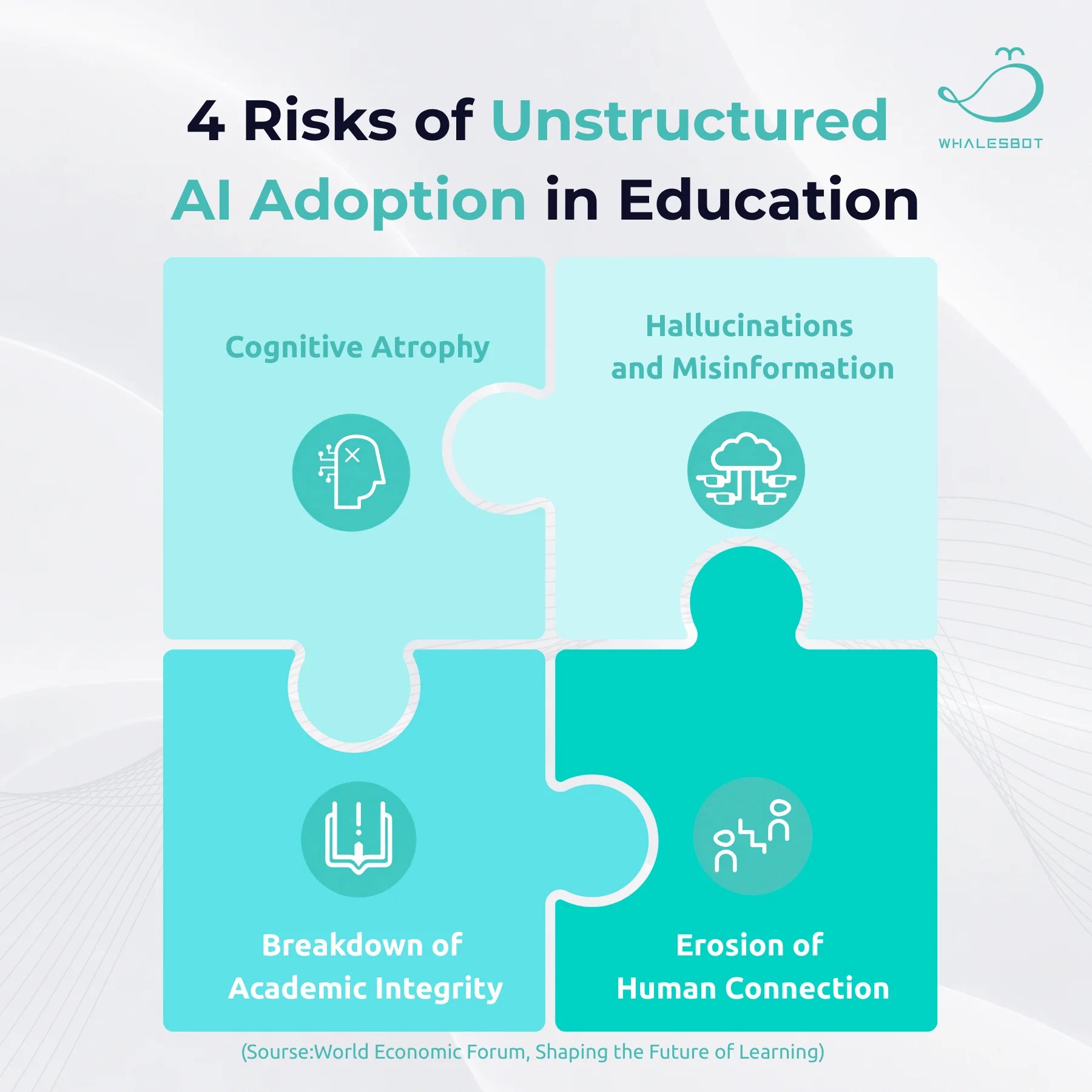
·Cognitive atrophy
One of the biggest risks is that students may gradually skip the thinking process. When AI explains, summarizes, compares, drafts, and reasons on behalf of learners, students may get an answer without doing the cognitive work that builds understanding. Over time, this can weaken independent thinking, problem-solving, and the ability to stay with difficult ideas.
·Hallucinations and misinformation
AI-generated answers can sound confident, complete, and well-structured, even when they are inaccurate. For students, this creates a new challenge: they need to learn not only how to find information, but how to question it. Without strong AI, media, and digital literacy, fluent answers may be mistaken for reliable knowledge.
·Breakdown of academic integrity
AI also makes it harder for schools to define what counts as original student work. If a student uses AI to brainstorm, outline, rewrite, or generate a full response, where should the line be drawn? The issue is not only plagiarism. It is whether assessment can still show what a student understands, how they reason, and what they can do independently.
·Erosion of human connection
Learning is not only about content. It also depends on dialogue, guidance, collaboration, and trust. If AI tools replace too many moments of discussion, feedback, and peer interaction, students may lose important opportunities to develop communication, empathy, and collaborative problem-solving skills.
These risks may look different, but they point to the same underlying issue: AI tools are entering learning environments faster than the learning structures around them can adapt.
The goal is not to keep AI out of education. The goal is to make sure AI is used within a structure that protects thinking, supports responsible use, makes learning visible, and keeps human connection at the center of education.
What does AI readiness mean for schools?
If unstructured AI use can weaken thinking, trust, assessment, and connection, schools need a clearer way to understand what it means to be ready for AI. Readiness is not simply having AI tools available. It is about whether AI is supported by the right learning conditions.
The World Economic Forum’s AI Readiness Framework looks at this question across four connected levels:
·Enabling foundations
The basic conditions that make AI adoption safe, reliable, and sustainable, such as data governance, digital safety, infrastructure, connectivity, and financing.
·Institutional capacities
The school-level rules, processes, and support systems that help institutions use AI responsibly while protecting trust, well-being, and academic integrity.
·Pedagogical practices
The teaching methods, teacher support, assessment design, and AI literacy frameworks that shape how AI is actually used in learning.
·Learning experiences
The student-facing experiences where AI should support problem solving, collaboration, inclusion, personalization, and deeper understanding.
For schools, not every part of this framework can be addressed at once. Some areas, such as data governance, infrastructure, and financing, require broader system-level coordination. But the parts closest to teaching and learning can become a practical starting point.
That means schools can begin by asking more focused questions:
· Do students know how to use AI critically and responsibly?
· Do teachers have the resources and confidence to guide AI learning?
· Can assessment still show real understanding, not just polished AI-generated output?
· Are students still solving problems, building projects, and collaborating with others?
· Is AI learning part of a continuous pathway, or only a set of disconnected activities?
These questions bring AI readiness back to the everyday reality of schools. They show that readiness is not only about adopting new technology, but about designing the conditions that allow AI to support real learning.
AI readiness is not a product checklist. It is a way for schools to understand whether they have the right learning conditions for AI to support meaningful education. When these conditions are missing, AI may remain a tool students use. When they are intentionally designed, AI can become part of a learning experience that helps students think, create, apply, and grow.
Where should schools begin?
For most schools, AI readiness can feel too broad to act on immediately. Data governance, infrastructure, financing, policy, teacher training, assessment, and student well-being all matter. But schools do not need to solve every system-level issue at once before they begin.
A more practical starting point is classroom-ready AI learning. This means designing learning experiences where students can understand AI, use it responsibly, build with it, apply it through projects, and show what they have learned through visible outcomes.
In practice, this requires more than a single AI tool or a one-time classroom activity. Schools need the key parts of learning to work together: AI literacy, teacher support, hands-on practice, project-based learning, assessment, and real-world application.

This is the direction behind WhalesBot’s AI Foundations Ecosystem. It is designed to connect the essential parts schools need to make AI learning more practical, structured, and easier to implement in real classrooms.
·AI Literacy helps students build foundational understanding of AI concepts, responsible use, and how AI connects with everyday life.
·Physical AI makes AI visible and tangible through robotics, sensors, coding, and intelligent systems, helping students move from abstract concepts to hands-on exploration.
·Teacher Support gives educators the resources and guidance they need to bring AI learning into classroom practice with more confidence.
·Project Learning connects AI concepts with real-world scenarios, so students can apply what they learn through meaningful tasks and problem-solving experiences.
·Assessment helps schools observe learning outcomes through project portfolios, feedback, and continuous improvement, rather than relying only on final answers.
·Community and Competition extend learning beyond individual lessons, giving students opportunities to share ideas, collaborate, and apply AI skills in wider contexts.
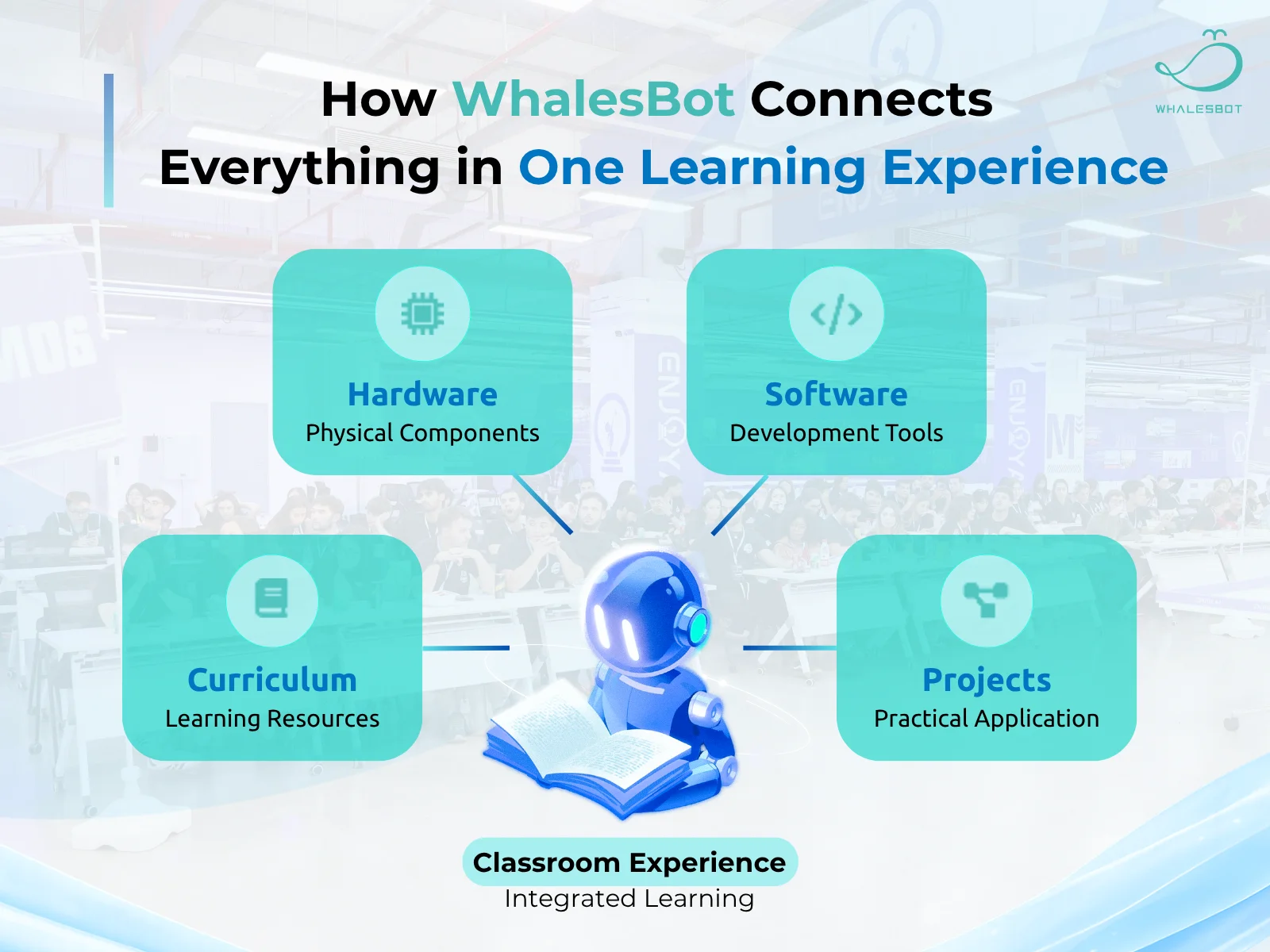
In practical terms, WhalesBot supports implementation by connecting robotics hardware, coding and AI practice software, structured curriculum resources, and real-world project scenarios. Instead of asking schools to organize separate tools and activities on their own, these resources are designed to support the same learning journey.
Students can explore AI concepts, build with physical AI systems, practice coding and model training, apply skills through projects, and make their learning visible through portfolios, feedback, and project outcomes. For teachers, this also makes AI education easier to plan, deliver, and scale across different classrooms.
Together, these parts help AI learning move from isolated exposure to structured progression. Students do not only learn what AI is. They can begin to understand AI concepts, build coding and physical AI skills, apply them through projects, and reflect on their learning outcomes.
This does not replace the broader system-level work needed for AI readiness. Instead, it gives schools a practical place to begin: the learning experience itself.
From AI use to structured AI learning
AI will continue to shape how students learn, create, and interact with knowledge. But the future of AI education will not be defined by tools alone. It will be defined by how schools design the learning experiences around those tools.
Structured AI learning helps students move beyond using AI for quick answers. It gives them a clearer pathway to understand AI, use it responsibly, build with intelligent systems, apply ideas through projects, and show what they have learned through visible outcomes.
For schools, the real shift is from AI access to AI learning design. When AI is placed within a connected learning ecosystem, it can support deeper understanding, hands-on creation, problem-solving, collaboration, and long-term skill development.
At WhalesBot, we support this shift through classroom-ready AI learning experiences that connect AI literacy, physical AI, coding, robotics, curriculum, projects, assessment, and competition-based practice.
Learn how WhalesBot supports structured AI learning for schools:
https://www.whalesbot.ai/resources/ai-education


