

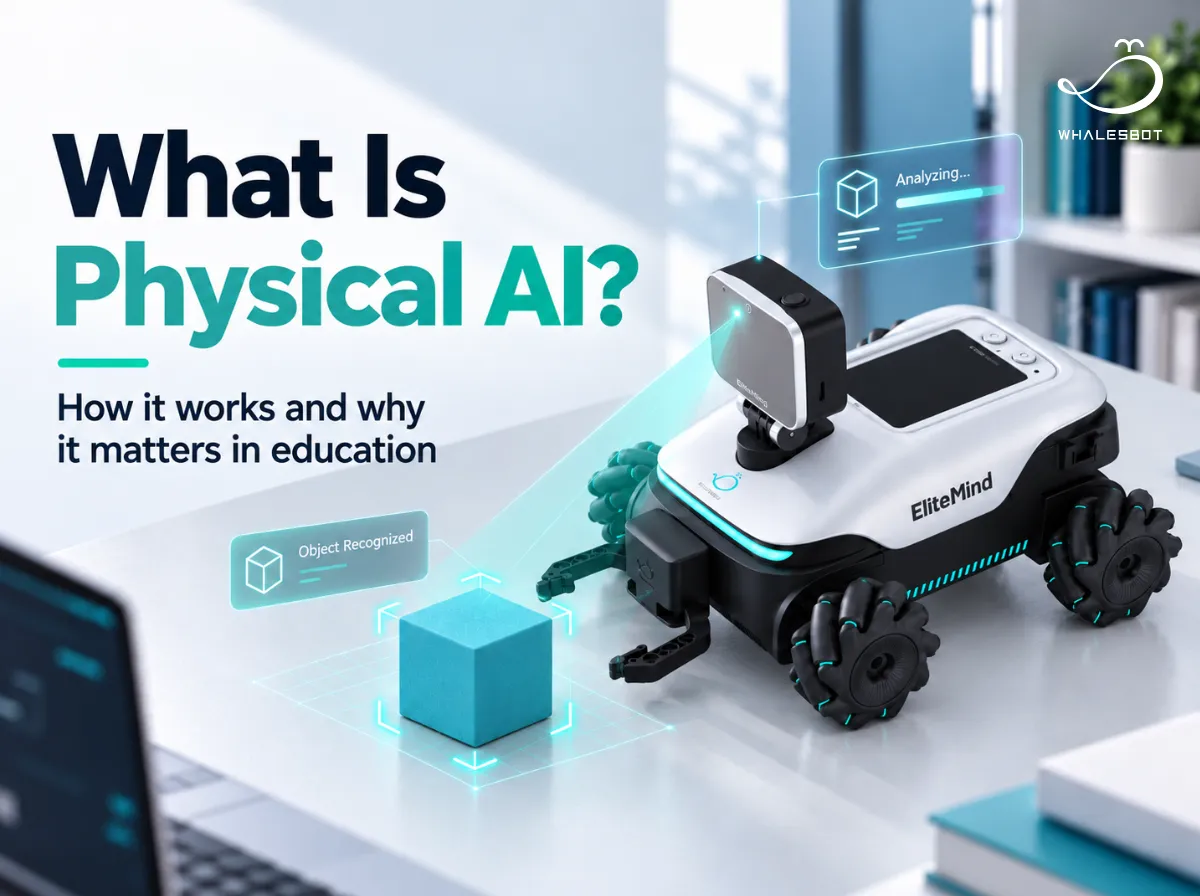


AI can generate text, analyze information, and answer complex questions in seconds. Yet much of what we experience as AI still happens within the digital world.
Physical AI is bringing intelligence into the physical world. By combining perception, reasoning, and action, it enables machines to interact with their surroundings, from autonomous vehicles and industrial robots to educational robots that recognize objects and respond to their environment.
As Physical AI becomes more widely adopted, it also opens up new possibilities for how the next generation learns about intelligent technologies. This article explores what Physical AI is, how it works, where it is used today, and what it could mean for the future of AI and STEM education.
What Is Physical AI?
Physical AI refers to artificial intelligence systems that can perceive, understand, and act in the physical world. By integrating AI models with sensors, cameras, and physical systems, it enables machines to interpret their surroundings, make decisions, and respond to real-world conditions.
Physical AI builds on advances in artificial intelligence and robotics, connecting intelligent decision-making with physical interaction. While these fields overlap, each has a different focus:
Generative AI: Creates new content, such as text, images, audio, and videos, based on patterns learned from data.
Robotics: Focuses on designing, building, and operating robots that perform physical tasks, ranging from simple programmable robots to advanced autonomous systems.
Physical AI: Focuses on AI-driven interaction with physical environments, combining environmental awareness, decision-making, and adaptive action.
How Does Physical AI Work?
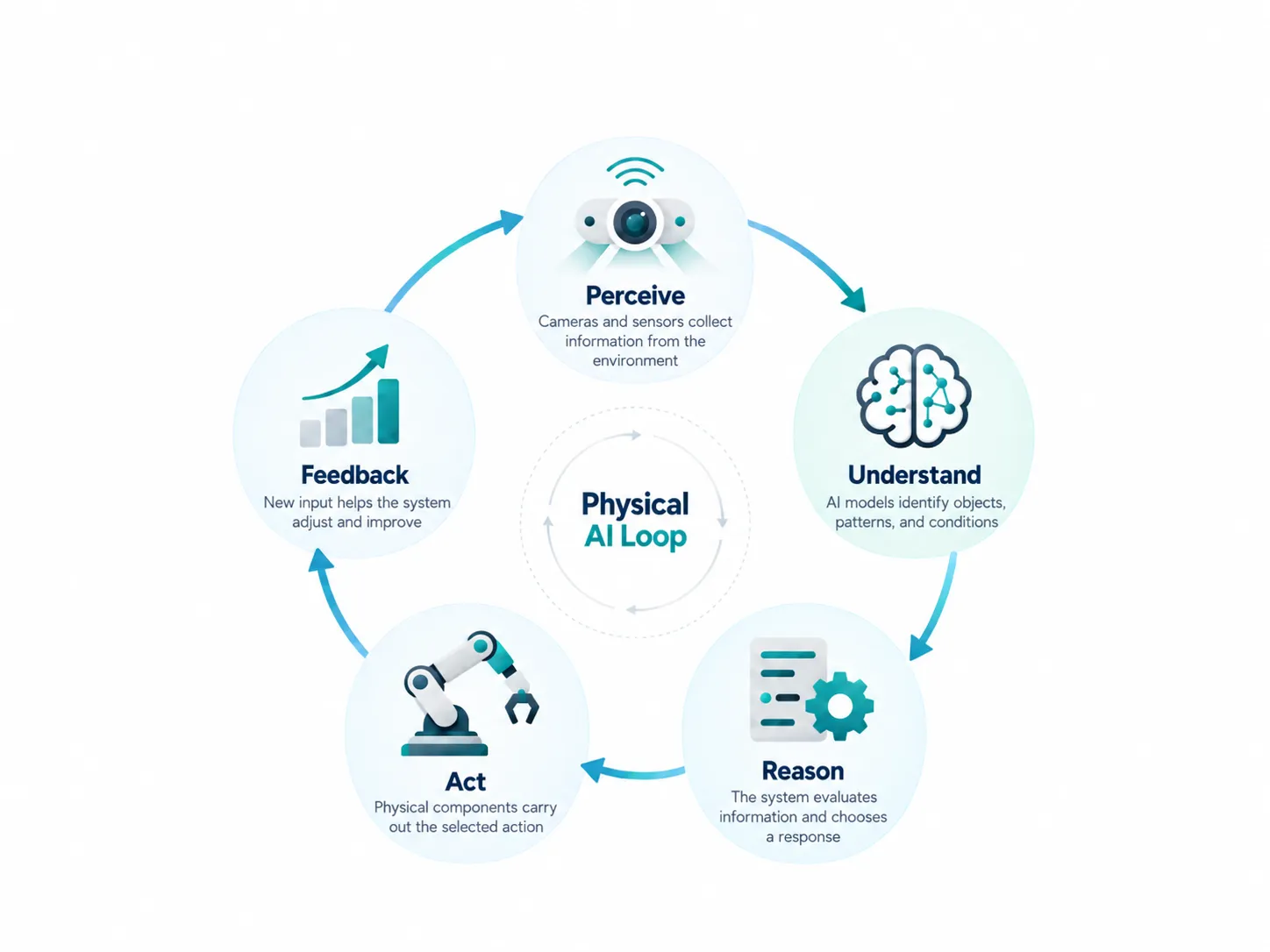
Physical AI combines sensory input, AI-driven decision-making, and physical action in a continuous process. By using feedback from its environment, the system can adjust its behavior as conditions change.
This process can be understood through five key steps:
Perceive: Cameras and sensors collect information about the surrounding environment, such as objects, movement, distance, or sound.
Understand: AI models process sensory data to recognize objects, identify patterns, and interpret environmental conditions.
Reason: The system uses this information to evaluate possible actions and select an appropriate response based on its goals.
Act: Motors, robotic arms, wheels, or other physical components carry out the selected action.
Feedback: Sensors capture the results of an action, allowing the system to detect changes or errors and adjust its next move.
For example, an AI-powered sorting robot can use a camera to identify different objects on a conveyor belt, determine where each item belongs, and control a robotic arm to place it in the correct location. If an object moves or the robot fails to grasp it, new sensor information helps the system adjust and try again.
Physical AI in Action
Physical AI is already being applied in a growing range of real-world settings, including:
Transportation: Self-driving vehicles use AI and sensors to navigate roads, detect obstacles, and adapt to changing traffic conditions.
Manufacturing & Logistics: Intelligent robots handle assembly, sorting, and warehouse operations, adjusting their movements based on real-time feedback.
Healthcare: Intelligent rehabilitation robots use sensors and AI to analyze patient movements and adjust physical assistance during therapy.
Agriculture: Smart farming machines use computer vision to identify crops and weeds, monitor field conditions, and carry out targeted operations.
Education: Physical AI robots bring intelligent systems into the classroom, allowing students to explore AI through object recognition, autonomous movement, and hands-on projects.
Why Does Physical AI Matter in STEM Education?
For educators, Physical AI offers a way to make AI concepts more tangible, connect different technologies, and bring learning into real-world practice. Through hands-on interaction with physical devices, students can explore how intelligent systems work beyond the screen.
1. Make Abstract AI Visible
AI can be difficult to teach when much of its operation happens behind the screen. Physical AI makes these concepts more tangible by connecting sensory input and AI-driven decisions with observable physical actions.
Students can see how intelligent systems respond to objects, movement, or sound, helping them understand how AI decisions lead to real-world outcomes.
2. Connect AI, Coding & Robotics
Physical AI brings together AI models, coding, sensors, and robotics in a single learning experience.
Through hands-on projects, students can explore how these components interact, understanding how changes in programming, sensor input, or AI decisions affect a robot's behavior.
3. Move From AI Concepts to Real-World Application
Physical AI allows students to put AI concepts into practice. By developing programs, testing them on physical devices, and refining their solutions through feedback, students can explore how intelligent systems operate in real-world conditions.
This creates a learning path from understanding AI to building with AI and applying AI in the physical world.
Bringing Physical AI Into the Classroom With WhalesBot
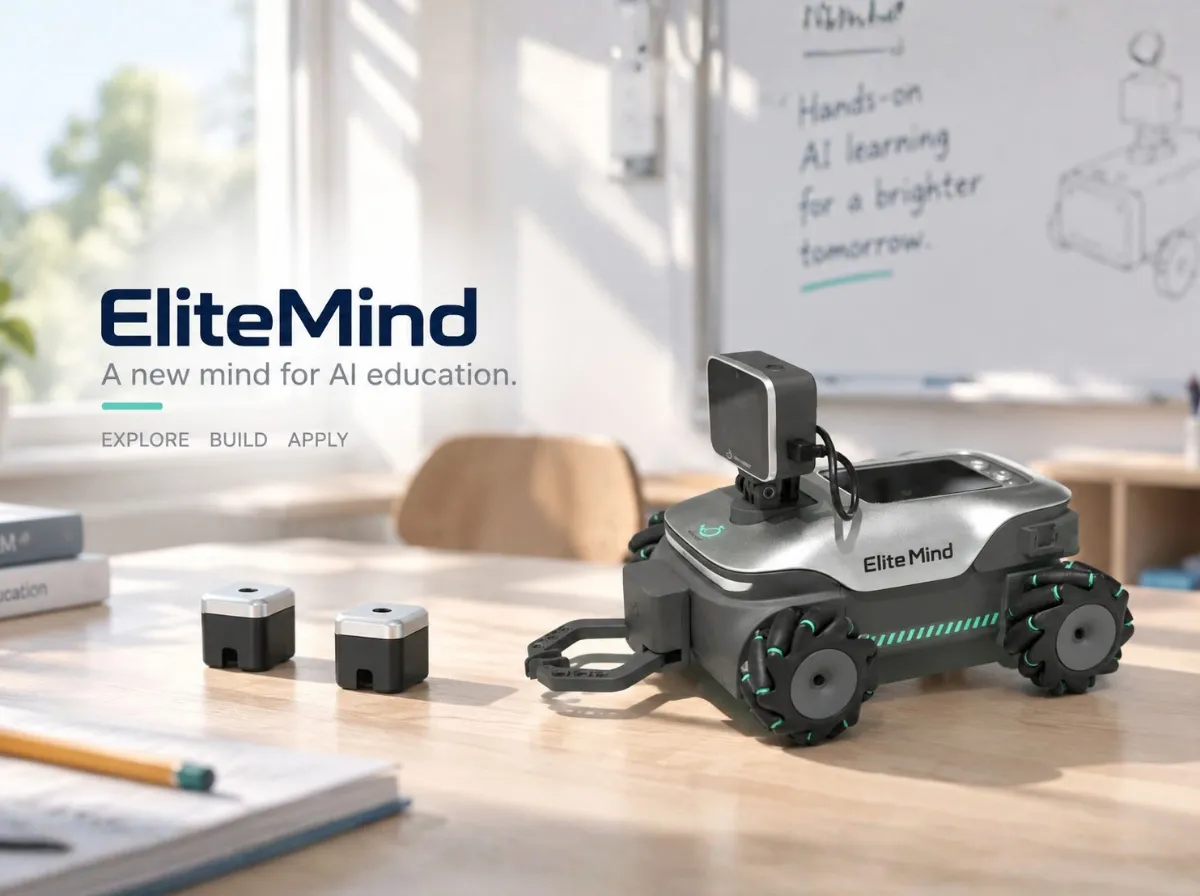
WhalesBot connects structured AI learning with hands-on Physical AI practice through OceanLevel, EliteMind, and W-Hong LLM.
With OceanLevel, students can explore AI concepts, follow project-based courses, and develop models and programs. These can then be brought into the physical world through EliteMind, a modular Physical AI robot that combines sensing, intelligent interaction, and physical control.
Supporting this learning experience, W-Hong LLM provides AI capabilities for intelligent interaction, helping students explore how AI can respond and operate through physical systems.
Together, these technologies connect AI learning, development, and real-world experimentation, supporting a learning journey from understanding AI to building with AI and applying it in the physical world.
Interested in exploring Physical AI in education? Learn more about WhalesBot EliteMind.

.png)