



The future is increasingly being built through science, engineering, data, and AI. Yet the people shaping that future still do not fully reflect the world technology is meant to serve. Girls and women remain underrepresented across the STEM pathway, from education and employment to leadership and decision-making.
This gap is not simply the result of individual interests or abilities. It develops over time as early stereotypes, uneven encouragement, limited role models, and unsupportive environments influence whether girls enter STEM, continue learning, and see themselves progressing within it.
This article examines what the gender gap in STEM looks like today, why greater participation matters for both equal opportunity and better innovation, and what schools can do to help more girls explore, build, and grow through STEM learning.
What Does the Gender Gap in STEM Look Like Today?
More women are entering higher education, but participation in STEM has not kept pace. Women account for only 35% of STEM graduates worldwide, and that figure has remained largely unchanged for the past decade. The problem, then, is not simply access to education. It is that broader educational progress has yet to translate into equal access to every field of study.
The gap widens further as women move from education into the workforce. Women make up just over 28% of the global STEM workforce, compared with more than 47% of the non-STEM workforce. A STEM degree may open the door, but it does not guarantee that women will find the opportunities, support, and working conditions needed to build a lasting career. The challenge is therefore not only bringing women into STEM, but helping them stay.
Representation falls further at the leadership level. Women hold 24.4% of managerial positions in STEM, but only 12.2% of STEM C-suite roles. As the numbers narrow, so does women’s influence over which research receives investment, which products are developed, and how new technologies are governed.
The STEM gender gap is not only about who enters the field. It is also about who is able to stay, progress, and shape its future.
Why Does the STEM Gender Gap Persist?
Girls rarely wake up one day and decide that STEM is not for them. Instead, their distance from STEM often grows gradually, as repeated messages about ability, belonging, and future possibilities begin to shape how they see themselves in these fields.
·Early stereotypes matter because they influence how girls interpret their own ability.
Even when girls perform strongly in math and science, they may receive fewer signals that they belong in those fields. When books, media, and classroom examples rarely show women as scientists, engineers, or technology creators, STEM can start to feel like someone else’s space. Confidence, in this sense, is not something girls simply have or lack. It grows from the feedback, opportunities, and evidence of ability they encounter.
·By secondary school, those impressions begin to shape real choices.
Subjects such as physics, calculus, and computer science often open the door to engineering, AI, and other technical fields. Without enough exposure, encouragement, or a clear understanding of where these subjects can lead, girls may step away before they have had the chance to discover whether they enjoy or excel at them.
·The barriers do not disappear once women graduate.
Workplace culture and limited support for career progression can make it harder for women to remain and advance in STEM, showing why the pathway must support participation at every stage.
Why Does Girls’ Participation in STEM Matter?
As AI, big data, cybersecurity, and technological literacy become some of the fastest-growing skills, participation in STEM will increasingly shape who can access the education and careers influencing the future. Not every girl needs to pursue a STEM career, but every girl should have the chance to understand these fields before early stereotypes, limited exposure, or a lack of encouragement narrow her choices.
The impact goes beyond individual opportunity. The people involved in scientific research, engineering, and AI development help decide which problems receive attention, what data is collected, and whose needs are treated as the default. UNESCO has reported that women represent only around 22% of AI professionals, leaving them underrepresented in a field whose systems increasingly influence healthcare, finance, education, and public services.
This lack of representation can contribute to real blind spots. Women were historically underrepresented in medical research, creating gaps in knowledge about women’s health. Vehicle safety testing has often relied heavily on male-based body models, while facial recognition systems have shown different error rates across demographic groups. These problems have complex causes, but they point to the same risk: when the people developing technology do not reflect the people affected by it, important experiences and needs are easier to overlook.
Bringing more women into STEM is therefore not only about creating fairer opportunities. It can also broaden the questions science asks, challenge assumptions in research and design, and lead to solutions that work better for more people.
What Can Schools Do to Support More Girls in STEM?
·Start Early With Hands-On STEM Learning
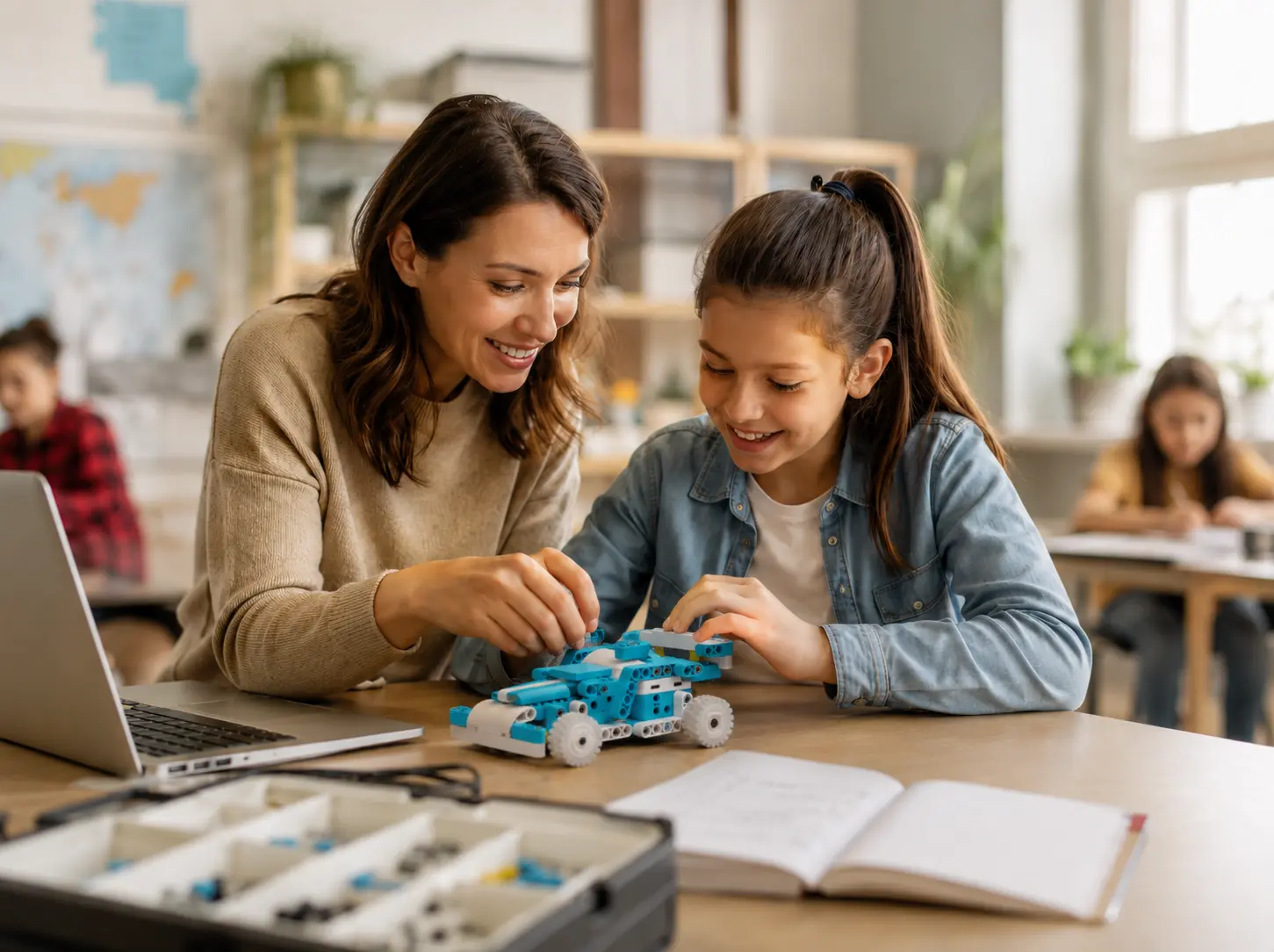
Hands-on projects help girls experience STEM as something they can actively do. Building, coding, testing, and troubleshooting turn abstract ideas into visible results, allowing confidence to grow from real progress rather than encouragement alone.
WhalesBot supports progressive, hands-on STEM learning through robotics and AI learning systems designed for different age groups. At Stream Scandinavia in Sweden, where students use WhalesBot robots, project leader Leila Khammari has observed that girls often show strong interest in technology at younger ages and keep working until they understand how the robot functions. The lesson is simple: schools may not need to create girls’ curiosity from scratch, but they do need to give it space to grow.
·Build Confidence Through Trust and Encouragement
Positive feedback from teachers can shape how girls see their own ability. This matters especially when stereotypes have already made them question whether they belong in STEM. Encouragement can make girls more willing to speak up, try difficult tasks, and keep going when something does not work.
Irish student Angie Sewell saw the impact of this support when her teachers encouraged her to take part in an international robotics challenge in Beijing. Although she had encountered the stereotype that engineering was not meant for girls, their trust gave her the confidence to build, compete, and take on unfamiliar challenges. Looking back, she said her teachers had believed in the students before they fully believed in themselves.
Her story shows how trust from educators can become the starting point for confidence: sometimes, students begin to see their own potential because a teacher sees it first.
·Create a Clear Path for Progression
Girls are more likely to stay engaged when they can see where their STEM learning can lead next. Classroom projects can gradually develop into more independent challenges, team-based problem-solving, public showcases, and international exchange.
Robotics competitions such as ENJOY AI can provide this kind of progression. They give students the chance to apply coding, engineering, and robotics skills to more complex problems, make decisions independently, and exchange ideas with peers from different backgrounds. A strong STEM experience should not end with one project. It should lead naturally to the next challenge.
·Make Female Role Models More Visible
Seeing women such as NASA mathematician Katherine Johnson and astronaut Mae Jemison in lessons can help girls picture women not only participating in STEM, but shaping its history. Their stories challenge the narrow image of who a scientist, engineer, or technology leader can be. Schools can make these examples more visible by including women’s contributions throughout STEM lessons, rather than limiting them to occasional profiles or special events.
Female mentors can make that possibility feel closer to everyday life. Teachers, university students, researchers, and engineers can share what STEM study and work actually involve, answer questions, and offer continued guidance. Research on a year-long female mentoring program found improvements in girls’ confidence, STEM participation, career knowledge, and intentions to choose related subjects.
By introducing girls to inspiring women from STEM history and mentors they can connect with directly, schools can help them see both what women have already achieved and where their own paths might lead.
Toward a More Gender-Inclusive STEM Future
A more inclusive STEM future begins by giving girls the freedom to explore these fields before stereotypes narrow their choices. The goal is not simply to help more girls enter an unchanged STEM system, but to build one in which more people can participate, progress, and lead.
Through early hands-on learning and progressive STEM pathways, WhalesBot aims to create more opportunities for girls to see themselves as creators of technology.
Explore how WhalesBot supports progressive AI and STEM learning:
https://www.whalesbot.ai/resources/ai-education


