

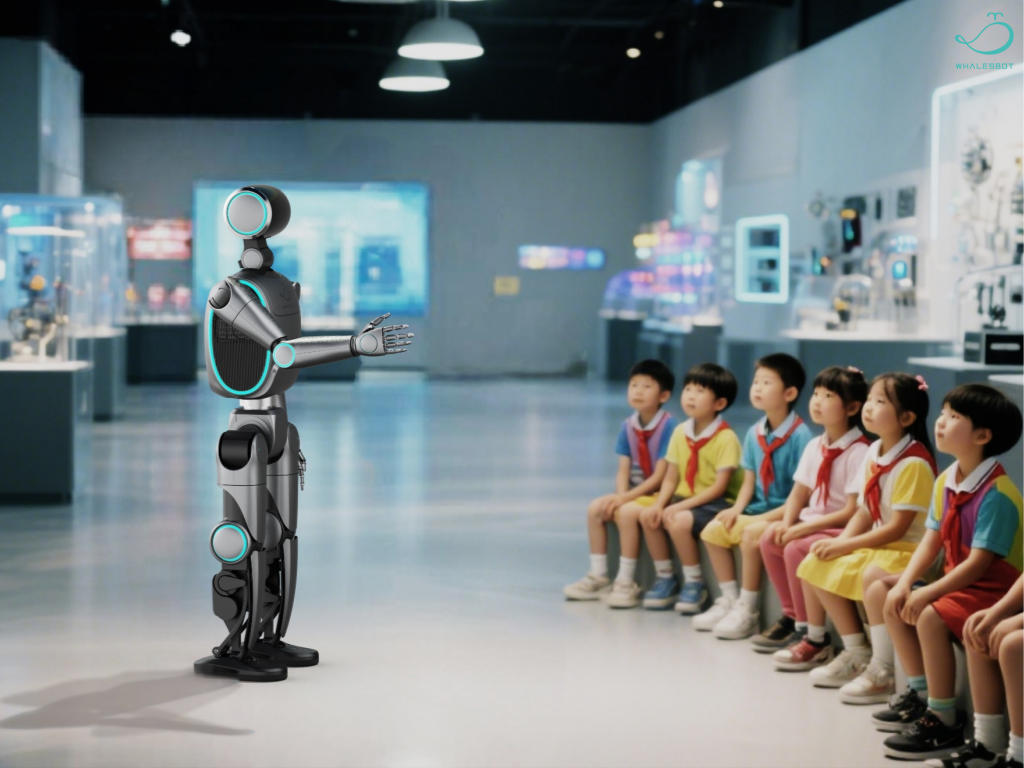


At the start of 2026, education systems around the world are entering a new chapter—one shaped by rapid progress in robotics and artificial intelligence (AI). What once felt futuristic is now gaining traction in real classrooms, from early childhood settings to high schools. The shift is no longer about whether AI and robots belong in schools, but how to use them meaningfully and responsibly.
According to a 2025 report from Fortune Business Insights, the global educational robot market reached USD 1.8 billion in value and is expected to grow to USD 2.32 billion in 2026. Looking further ahead, the market is projected to hit USD 18 billion by 2034, with a strong compound annual growth rate of 29.16%. This growth reflects rising demand for learning tools that promote hands-on exploration, creative thinking, and future-ready skills.
Governments and school systems in countries like China, Germany, South Korea, and the UAE are accelerating investment in this space. China has equipped tens of thousands of primary schools with robots, and Germany has launched national programs to put robotics kits into classrooms. In parallel, AI-driven platforms are being adopted across Singapore, the UK, and the US to support personalized learning, reduce teacher workload, and expand access to high-quality content.
This blog looks ahead to the most important trends shaping EdTech in 2026. We’ll explore how AI is supporting teaching, how robotics is becoming part of everyday instruction, and why screen-free coding is gaining popularity. We’ll also dive into the rise of computational thinking, next-generation learning tools, and global efforts to make educational technology more inclusive.
AI as the Classroom Co-Pilot
As we move into 2026, artificial intelligence is playing a larger role in the day-to-day experience of both teachers and students. Instead of replacing educators, AI is helping personalize instruction, streamline assessment, and make real-time adaptation possible. The shift is visible across classrooms worldwide where schools are experimenting with practical applications tailored to their local needs.
In South Korea, Seoul’s public middle schools have adopted AI-powered math platforms that adjust question difficulty based on a student’s pace and accuracy. These systems generate automated feedback while giving teachers snapshots of class performance, enabling them to provide more targeted support during instruction. Similarly, in Singapore, bilingual AI chatbots LangBuddy are being used in primary classrooms to support English and Mandarin language development. Students can ask the chatbot questions or practice vocabulary and sentence construction, and the system responds conversationally, helping reinforce comprehension skills.
In the United States, districts like Miami-Dade and Los Angeles Unified are deploying AI writing assistants that prioritize scaffolding over generation. Rather than writing for the student, these tools provide real-time feedback on logic and structure while operating within strict data-privacy frameworks to protect student identity. This shift allows teachers to focus on high-level composition skills, though it requires ongoing professional development to ensure AI feedback aligns with human grading standards.
AI literacy is also being formally introduced into more national curriculums. Germany has launched classroom pilots where students use visual tools to explore how AI makes decisions and what ethical questions arise around algorithmic bias and fairness. In the UAE, educators are using scenario-based learning to introduce AI ethics, focusing specifically on data sovereignty. As AI tools become more integrated, students are learning to distinguish between 'Open AI' (where data may be used for training) and 'Closed-Loop AI' (where student data remains private to the school). This shift ensures that as students build AI literacy, they are also becoming savvy guardians of their own digital footprints.
Teachers are benefiting on the backend too. In the UK, AI platforms like CENTURY Tech are helping schools analyze learning gaps, automate low-stakes quizzes, and plan differentiated instruction. These tools track long-term learning patterns and help educators better understand where students are struggling or excelling.
Though the tools vary by region and subject, the broader trend is clear: AI is becoming a supportive presence in the classroom. When thoughtfully implemented, it enhances a teacher’s ability to adapt content and create more responsive, personalized learning environments.
The next logical step in this shift toward tech-supported learning is the rise of educational robotics.
Robotics Becomes Core to the Curriculum
In 2026, educational robots are expected to shift from being enrichment tools to becoming integrated parts of daily learning. Robotics kits, which were once reserved for after-school clubs or tech labs, are now being embedded in formal curricula across age groups and subjects. The growing affordability of hardware and availability of teacher-ready materials are driving this transformation globally.
At the foundational level, early learners are introduced to robotics through hands-on, screen-free kits that teach logic and sequencing through physical play. Tools like WhalesBot’s U10, U10 Pro, U20, U20 Pro, U30 Pro, and S30, as well as widely known kits like Bee-Bot and KIBO, are used to build essential skills in pre-K through lower primary grades. These kits rely on tactile inputs—buttons, card-based or panel-based programming—helping young children develop computational thinking without needing screens.
In upper primary and secondary education, robotics shifts toward programmable systems that emphasize engineering, AI integration, and cross-disciplinary learning. Modular kits such as Lego Spike Prime, Makeblock’s mBot, and WhalesBot’s Eagle drones and Wobot 1S allow students to build robots that use motors, sensors, and cameras to complete complex challenges. In China, public schools integrate these systems into national STEM pathways. In the UAE, middle schoolers tackle robotics-based performance tasks as part of their digital literacy scores.
A notable development in 2026 is the entry of humanoid robots into specialized instruction. Platforms like Japan’s Nao and WhalesBot’s H7 are being utilized for Social-Emotional Learning (SEL) and special education, where their bionic form helps students practice non-verbal cues and social interactions in a controlled environment. While the high cost of humanoid hardware remains a barrier for universal adoption, their role as 'learning companions'—capable of modeling complex human movements and interactive dialogue—offers a unique pedagogical advantage that traditional tablets cannot provide.
As students gain confidence assembling, programming, and troubleshooting robots, they are not just building technical skills. They are developing critical thinking and creative problem-solving abilities that apply far beyond robotics. This evolution is changing how educators think about learning spaces. In 2026, schools are beginning to connect physical robotics with immersive digital platforms to offer more dynamic, interactive lessons. The next step in this transformation is the rise of virtual and augmented reality, where students no longer just study concepts but experience them directly.
Immersive Learning in Virtual Worlds (AR/VR in Education)
In 2026, virtual and augmented reality are no longer futuristic novelties—they’re becoming a core component of digital education strategies worldwide. As more schools seek to make learning visual, interactive, and emotionally engaging, immersive technologies are transforming how students experience subjects like science, math, engineering, and even social-emotional learning.
One of the key shifts driving this trend is the movement from passive content consumption to experiential learning. Instead of reading about a chemical reaction or watching a video of a robot navigating a maze, students are now stepping into these environments virtually—conducting simulations, testing code, and solving real-world problems in 3D spaces. These experiences bring abstract concepts to life and promote deeper engagement, especially for spatial and kinesthetic learners.
In STEM education, immersive learning is proving particularly powerful. Across countries like the U.S., UK, China, and the UAE, virtual science labs and AR-enhanced engineering challenges are being woven into weekly lessons. These tools allow students to run experiments too dangerous or expensive for physical labs, or prototype solutions to real-world challenges—without needing access to high-end equipment.
At the same time, immersive learning is expanding access to robotics and programming. Platforms like RoboVR, Prisms VR, and zSpace enable students to explore complex STEM concepts in simulated environments—from coding virtual robots to solving spatial math problems or assembling digital circuits. These tools support hands-on experimentation even in schools with limited lab equipment, making immersive STEM education more flexible and accessible for diverse learners.
Importantly, immersive learning is no longer confined to standalone devices or isolated pilots. With falling hardware costs and an expanding ecosystem of curriculum-aligned content, schools are embedding AR/VR into everyday instruction. For example, the Los Angeles Unified School District has deployed thousands of ClassVR headsets to enhance science and history instruction. In Broward County, Florida, Prisms VR is being used in middle and high school math classes to support inquiry-based learning, helping students explore real-world scenarios like epidemiology through spatial reasoning. In technical education, platforms like zSpace are enabling students to simulate engine repair, assemble circuits, and explore medical procedures using headset-free mixed reality displays—already adopted in over 3,500 U.S. districts, including Houston ISD and Chicago Public Schools.
This shift is closely tied to the push for personalized learning, yet it also highlights the digital divide. To ensure equitable access, schools are increasingly adopting hybrid immersive models. For example, browser-based platforms now allow students to engage in 3D robotics and science simulations on standard laptops, reducing the need for expensive VR headsets while supporting equitable access to high-quality digital learning. This 'simulation-first' approach allows under-resourced districts to provide high-level STEM training without the heavy hardware overhead.
Looking forward, immersive learning is becoming a foundation for deeper, more connected educational experiences. As students interact with content in virtual environments—whether designing robots, exploring ecosystems, or simulating real-world systems—they’re developing technical fluency alongside critical thinking. This shift is not just about engagement, but about preparing learners for a future where digital tools will be integral to solving complex problems. The next wave of innovation builds on this momentum, blending robotics, AI, and real-time interactivity to deliver learning tools that adapt to students’ needs and expand access to quality education.
Smart, Inclusive Tools Driving the Future of Learning
Looking ahead, the next wave of robotics and AI in education will go beyond task automation to focus on intelligent adaptation, emotional awareness, and equitable access. The next wave of robotics focuses on affective computing, where tools interpret signals like tone of voice or posture to sense frustration or engagement. While this 'emotionally aware' AI offers a breakthrough in personalized support, it also sparks critical 2026 debates regarding algorithmic bias and the ethics of emotional monitoring. Consequently, the most successful tools are those that use these signals to suggest 'brain breaks' or adjust difficulty levels, rather than those that store sensitive emotional data.
Meanwhile, the integration of multimodal interfaces—blending voice, gesture, touchscreen, and even eye-tracking—will make robotics tools more intuitive and accessible to younger learners and those with diverse needs. Kits designed with universal design principles are evolving to include adaptive feedback in multiple formats, giving students options to learn through sound, visuals, movement, or tactile input.
Another key development is the rise of AI-enhanced robotics platforms that adjust not just difficulty, but learning pathways. These systems may offer branching challenges based on student performance or even collaborate with generative AI to create custom problem sets or story-based missions on the fly. This kind of adaptability supports more inclusive and differentiated instruction—especially valuable in classrooms with wide-ranging ability levels.
Access is also being reimagined. Schools are turning to cloud-connected robotics and simulation platforms that allow students to code, test, and collaborate from anywhere. Combined with cheaper hardware and modular design, these tools lower entry barriers for under-resourced schools. The result is a growing ecosystem of robotics experiences that are not only more powerful but more equitably distributed.
In short, the future of robotics in education isn’t just more advanced—it’s more responsive, inclusive, and meaningful. As these tools mature, the emphasis will shift from novelty to deep impact, ensuring that all learners can participate in building the skills they need for a rapidly evolving world.
Challenges and Ethical Hurdles
While the potential of EdTech is vast, the transition has not been without significant hurdles. In 2026, there are three primary challenges:
The Maintenance Gap: High-tech robotics require specialized upkeep. Many schools have found that without a dedicated 'Tech-Sexton' or on-site maintenance plan, expensive kits can quickly become 'shelf-ware' if they break or require complex software updates.
Teacher Cognitive Load: Educators are facing a new form of burnout: digital fatigue. While AI is meant to reduce workload, the initial curve of learning to prompt, manage, and troubleshoot multiple AI agents and robotic fleets has added a new layer of administrative stress. Successful districts are those that have prioritized 'time-neutral' integration, where tech is only used if it saves more time than it consumes.
The Ethics of Affective Computing: As 'emotionally aware' robots begin to sense student frustration or joy, the question of emotional privacy has moved to the forefront. Experts argue that while sensing a student’s mood can help personalize a lesson, it also risks a 'surveillance' atmosphere. In response, 2026 has seen the rise of 'Privacy-First' certifications for educational hardware, ensuring that emotional data is processed locally on the device and never uploaded to the cloud.
Conclusion
As we navigate through 2026, it is clear that education has entered a phase of purposeful integration. The conversation has shifted from the mere presence of technology to the quality of its application. AI and robotics are no longer peripheral novelties; they have become essential infrastructure that reconfigures how students synthesize information and solve complex, real-world problems.
From adaptive tutoring systems that pinpoint learning gaps to bionic robots that facilitate social-emotional growth, today’s innovations are not just personalizing the path—they are empowering students to become the architects of their own curricula. By mastering these tools, learners are gaining the "agentic" skills—critical analysis, ethical judgment, and technical fluency—required to thrive in a world where AI is a constant collaborator.
Yet, this technological leap only succeeds because of the human-in-the-loop. As classrooms become more automated, the role of the teacher has evolved from a conveyor of information to a high-level mentor and ethical guide. Educators remain the essential filter, ensuring that every digital interaction serves a pedagogical purpose and that data-driven insights are tempered with empathy and intuition.
Ultimately, the future of EdTech in 2026 is defined by this balanced partnership. We are building a system where machines handle the routine, and humans provide the inspiration, creating a launchpad for a generation that is not just tech-savvy, but tech-wise.


