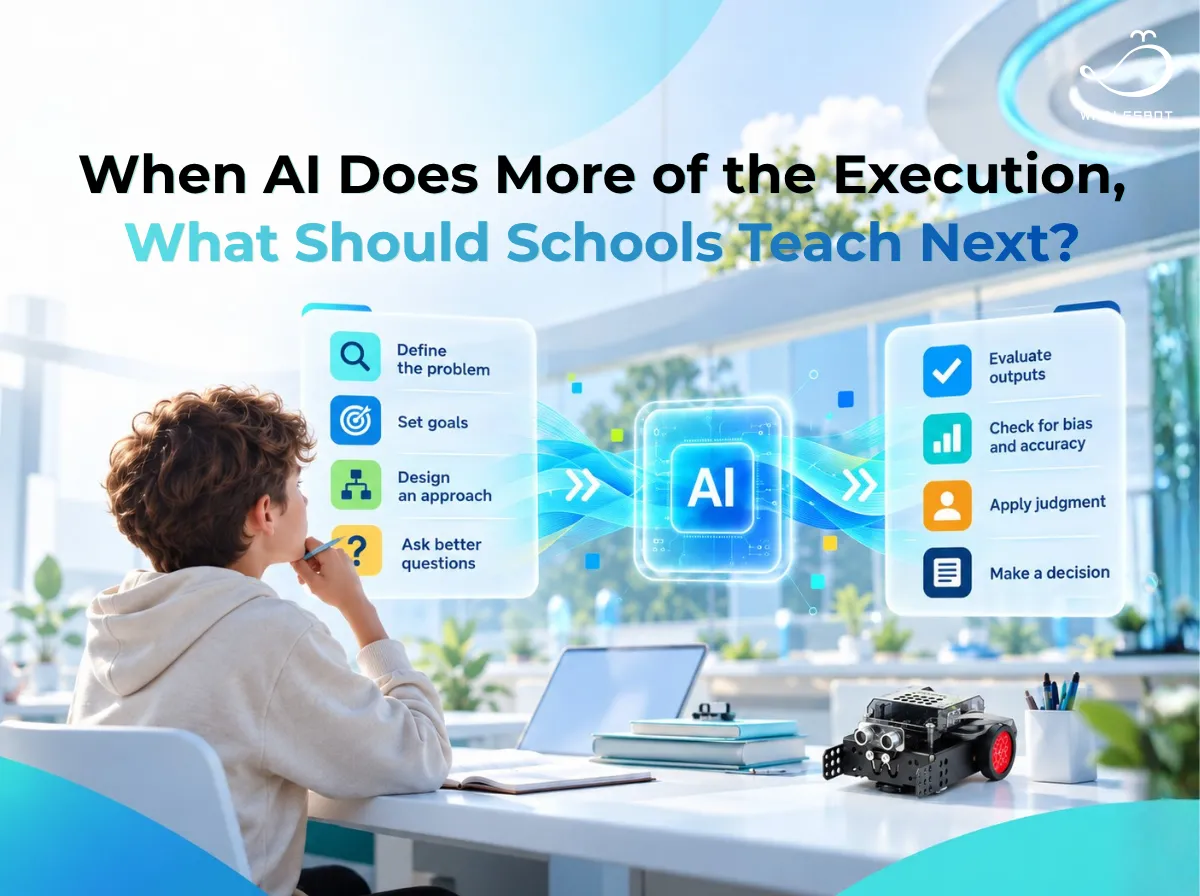


As AI becomes increasingly capable of analysis, content generation, optimization, and routine execution, the question is no longer only which jobs it may replace. A more interesting shift is happening inside the work itself. A recent World Economic Forum article suggests that as AI takes on more of the execution layer, human value may increasingly lie in framing problems, designing how AI should operate, reviewing its outputs, and deciding what happens next.
This article explores what this emerging division of work could mean for education. We look at how responsibilities between humans and AI may be changing, which human capabilities could become more important as a result, and how schools can help students prepare for this future.
Human Work Is Being Redefined in the Age of AI
Rather than thinking simply in terms of “humans versus AI,” a more useful way to understand the future of work is to look at how responsibilities are being redistributed within the same workflow. As AI takes on more analysis, content generation, optimization, and routine execution, human involvement may become increasingly important before and after that execution stage.
From Execution to Framing and Judgment
This changing division of work can be understood across five stages:
· Framing: Defining the real problem, the goal, and what a successful outcome should look like.
· Design: Setting the conditions for AI to operate, including inputs, assumptions, constraints, and boundaries.
· Execution: Processing information, generating content, optimizing options, or automating actions. This is where AI is taking on a larger share of the work.
· Review: Evaluating whether AI outputs are accurate, appropriate, and meaningful in the real-world context.
· Decision: Determining what action should ultimately be taken and taking responsibility for the outcome.
The important change, then, is not that humans disappear from the workflow. Instead, human contribution may become more concentrated around problem definition, system design, contextual judgment, and decision-making.

Two Emerging Human Roles Around AI
To illustrate this shift, the article describes two emerging roles on either side of AI execution: the AI Work Architect and the AI Steward.
· AI Work Architect: Shapes work before AI execution by defining objectives, breaking down tasks, deciding what should be delegated to AI, and setting the conditions and boundaries within which it operates.
· AI Steward: Brings AI outputs back into real-world context by validating results, considering their wider impact, and deciding whether an AI-supported action should be accepted, modified, rejected, or escalated.
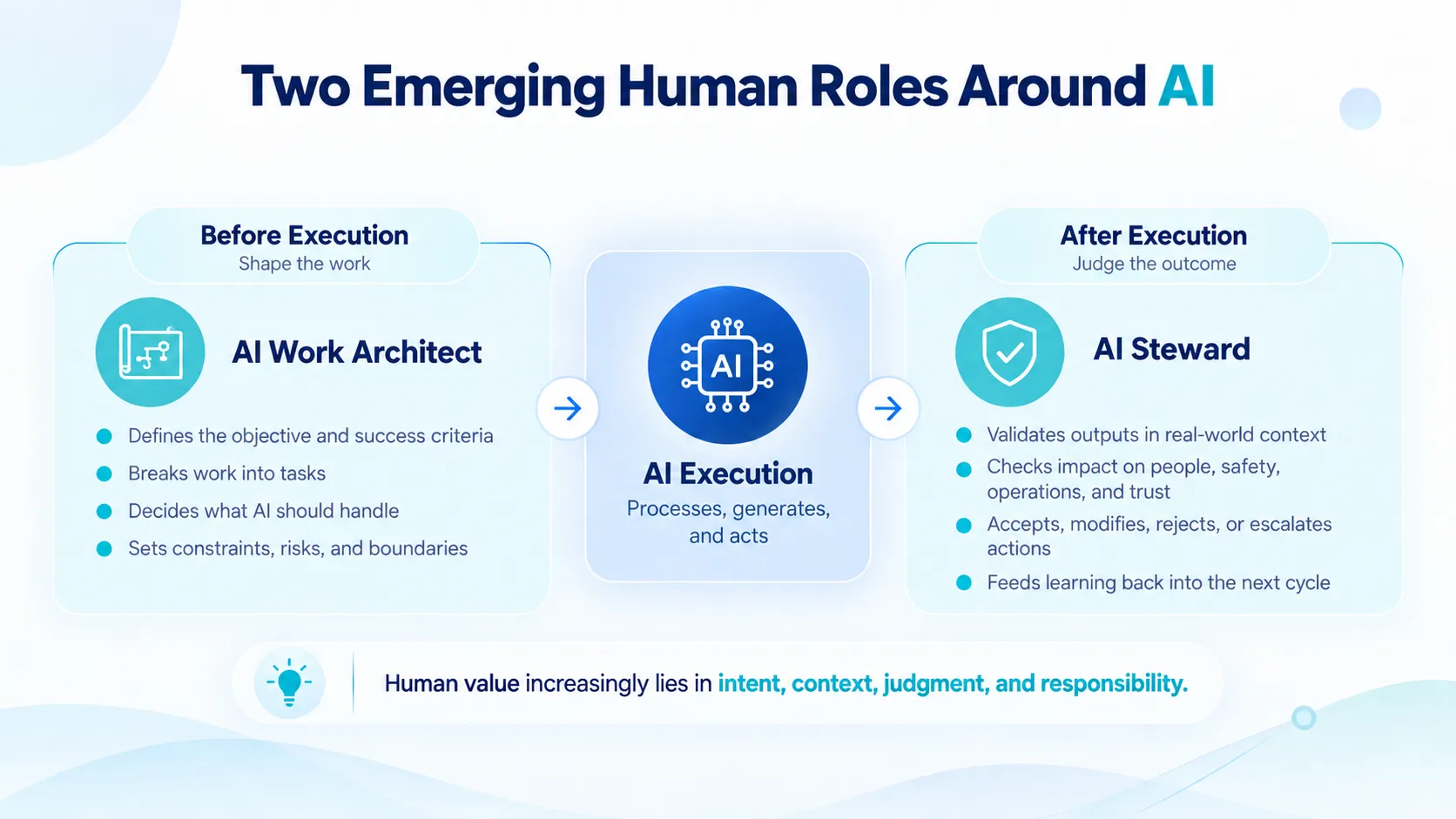
These may not necessarily become universal job titles. More importantly, they illustrate how responsibilities around AI could increasingly become part of existing roles.
As AI makes execution faster and easier, the real bottleneck may move elsewhere: deciding what is worth doing in the first place and what deserves to become action in the real world. Human value, in this sense, becomes increasingly tied to intent, context, judgment, and responsibility.
What Human Capabilities Matter More in an AI-Driven Workplace?
This changing division of work may still be evolving, but the capabilities behind it are already becoming increasingly relevant. If AI takes on more of the execution, human value may depend less on simply completing tasks and more on the ability to understand, direct, question, and make decisions around AI.
This means moving beyond basic tool familiarity. Knowing how to prompt an AI system or generate an output is useful, but working effectively with AI requires a broader set of capabilities:
· AI literacy: Understand what AI can and cannot do, recognize its limitations and risks, and know when human involvement is still essential.
· Problem framing: Define what actually needs to be solved before asking AI to solve it, including the goal, context, and constraints surrounding the task.
· Critical evaluation: Question AI outputs, verify information, identify what may be missing, and avoid treating a confident response as automatically reliable.
· Judgment and agency: Decide when to rely on AI, when to intervene, and how AI-generated ideas or actions should ultimately be applied in the real world.
Together, these capabilities reflect a more active relationship with AI. People are not simply users receiving outputs from a tool. They are increasingly expected to shape how AI is used, evaluate what it produces, and remain responsible for the decisions that follow.
For education, this creates an important shift in emphasis. The question is no longer only “Can students use AI?” but also “Can they think around it?” Students still need to question, test, evaluate, and decide with AI rather than passively delegating the thinking itself.
This is where AI literacy begins to move from knowing how to use a tool to knowing how to work thoughtfully and responsibly with one.
How Can Schools Build These Capabilities?
Preparing students for an AI-shaped future requires more than teaching them how to use individual tools. Schools can help by creating a learning journey that develops understanding, hands-on experience, and real-world application over time.
1. Build a Continuous AI Learning Pathway
AI literacy should develop through a continuous learning pathway, not isolated lessons. Students need opportunities to move from understanding AI concepts to coding, Physical AI, and increasingly complex projects as their skills grow.
2. Make Learning Hands-On and Problem-Driven
Students learn more when they have to build, test, troubleshoot, and improve. Robotics and coding turn AI from something they simply use into something they can explore, question, and shape through real problem-solving.
3. Connect Learning With the Real World
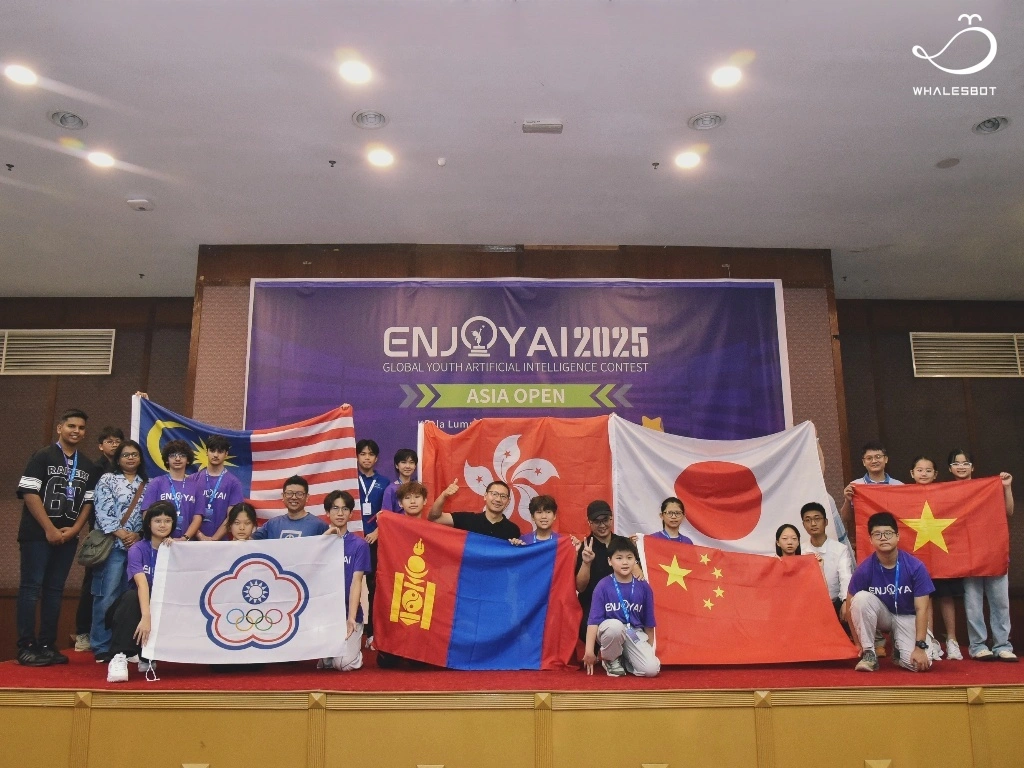
Real-world projects and competitions give students a reason to apply what they know under new constraints, collaborate with others, and make decisions beyond the classroom. Programs such as ENJOY AI can extend this learning into international competition experiences.
At WhalesBot, these experiences come together as one connected STEM & AI learning ecosystem, bringing hardware, software, curriculum, projects, assessment, and competition into the same learning journey.
The goal is not simply to help kids use AI, but to help them grow into people who can understand it, build with it, question it, and decide how it should be used.
Explore how WhalesBot helps schools build future-ready STEM and AI learning experiences: https://www.whalesbot.ai/